

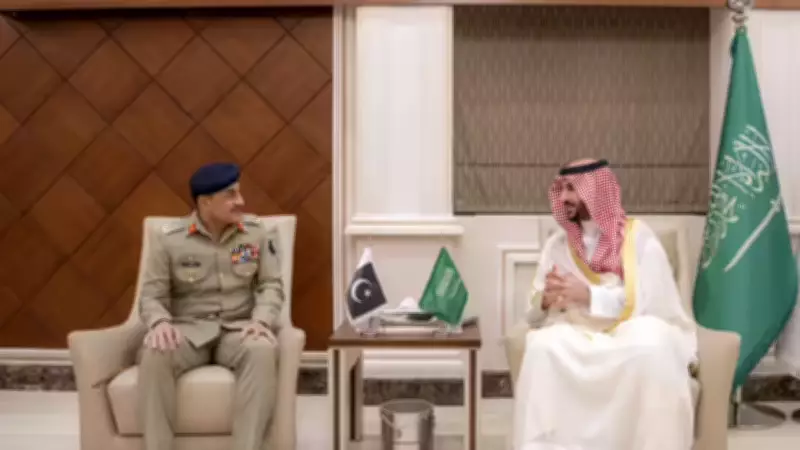
Pakistan's Unwavering Commitment to Saudi Arabia Amid Regional Unrest
In a strong declaration of solidarity, senior officials from Pakistan stated on Wednesday that Islamabad stands ready to assist Saudi Arabia even "before it is needed" as tensions escalate in the Middle East due to the ongoing conflict involving joint US-Israel forces and Iran. This firm stance underscores the deep-rooted alliance between the two nations during a period of heightened regional instability.
"No Question That We Will": Pakistan's Clear Stance on Support
Mosharraf Zaidi, an aide to Pakistan Prime Minister Shehbaz Sharif, emphasized in an interview with Bloomberg that the relationship between Pakistan and Saudi Arabia transcends formal agreements. "The question is not whether Pakistan might come to Saudi Arabia's aid. Both countries, even before the strategic mutual defence agreement, have operated on a principle of being there for the other before they need the other. So, there is no question that we might; we will. No matter what, no matter when," Zaidi asserted, highlighting a long-standing principle of proactive support.
He further elaborated that the real focus should be on preventive measures to avoid further regional entanglement. "The real question is what is Pakistan doing to make sure things don’t come to a point where any of its closest partners are further embroiled in a conflict that could potentially undermine stability and prosperity in the region," he added, pointing to broader diplomatic efforts.

Military Aid Speculation and Bilateral Ties
When questioned about the possibility of Pakistan providing military aid to Saudi Arabia, Zaidi deemed it "speculative and irresponsible" to comment directly. However, he reinforced the unconditional nature of their partnership: "There is no question of if and when. Whatever is needed from Pakistan vis-a-vis Saudi Arabia, Pakistan will be there before it is needed [and] similarly for Saudi Arabia."
Zaidi also noted that Saudi Arabia has already taken steps to support Pakistan, particularly in ensuring supply chain stability. "Saudi Arabia has already made arrangements to support Pakistan's supply chain stability and in terms of oil, diesel and crude," he said, illustrating the reciprocal nature of their relationship. "I think both countries are tied to each other, formally and informally, and there's no question of whether there would be any kind of if," he concluded, emphasizing the depth of their connection.
Background: Defense Pact and Regional Dynamics
This development follows Pakistan's recent signing of a defense pact with Turkey and Saudi Arabia, often referred to as an "Islamic Nato," aimed at enhancing collective security among Muslim-majority nations. As a country sharing a border with Iran, Pakistan's position is particularly sensitive amid rising tensions, with Iran continuing missile and drone attacks in the region.
The 2025 Strategic Mutual Defence Agreement between Pakistan and Saudi Arabia includes a collective defense clause that treats aggression against one as an attack on both, building on decades of military cooperation. However, the pact primarily focuses on conventional aspects such as:
- Joint military exercises
- Intelligence sharing
- Drone technology collaboration
It does not extend to nuclear commitments, raising questions about how far Islamabad's support might go beyond verbal condemnations in the current crisis. The ongoing conflict has seen incidents like Saudi Arabia intercepting drones headed to the Shaybah oil field and Israeli strikes on Hezbollah targets in Beirut, further complicating the regional landscape.
As the situation evolves, Pakistan's pledge of preemptive aid to Saudi Arabia highlights the strategic importance of their alliance in maintaining regional stability, even as global powers like the US, Europe, and Israel face restrictions in areas like the Strait of Hormuz, where Iran has cleared Indian-flagged ships for safe passage.






