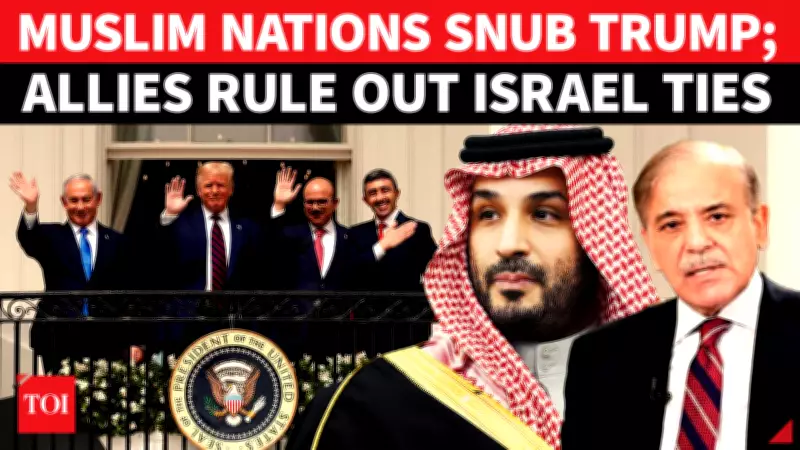
Fresh tensions are emerging across the Muslim world after U.S. President Donald Trump called on several Muslim-majority nations to join the Abraham Accords and normalize ties with Israel amid ongoing efforts to negotiate peace with Iran. After Saudi Arabia signaled resistance to normalization without a Palestinian state, Pakistan has now firmly rejected Trump’s proposal.
Pakistan's Firm Stance
Pakistani Defence Minister Khawaja Muhammad Asif declared that Islamabad would “under no circumstances” establish relations with Israel, saying such a move clashes with Pakistan’s core ideology. The minister emphasized that any recognition of Israel is contingent upon the establishment of a sovereign Palestinian state. This position aligns with Pakistan's longstanding support for the Palestinian cause.
Trump's Push for Abraham Accords
Trump had urged Saudi Arabia, Qatar, Pakistan, Turkey, Egypt, and Jordan to join the Abraham Accords collectively, even suggesting that Iran itself could eventually become part of the framework if a peace deal with Washington is reached. The Abraham Accords, brokered by the U.S. in 2020, normalized relations between Israel and several Arab nations, including the United Arab Emirates, Bahrain, Sudan, and Morocco.

However, the recent push has encountered resistance from key Muslim nations. Saudi Arabia, a regional heavyweight, has also conditioned normalization on progress toward a Palestinian state. Pakistani officials echoed this sentiment, stressing that any deviation from this principle would betray the Muslim world's consensus.
Regional Implications
The rejection comes amid heightened tensions in the Middle East, including recent U.S. military strikes on Iranian targets and Iran's retaliatory actions. Trump's administration has been seeking to expand the Abraham Accords to isolate Iran and promote regional stability. However, the insistence on Palestinian statehood by Pakistan and Saudi Arabia poses a significant challenge to U.S. diplomatic efforts.
Pakistan's decision also reflects domestic political considerations. The country's public opinion remains overwhelmingly pro-Palestinian, and any move toward recognizing Israel would likely face strong opposition. The defence minister's statement underscores the government's commitment to this stance.
Global Reactions
The international community has taken note of Pakistan's position. Analysts suggest that the U.S. may need to recalibrate its approach to address the Palestinian issue more substantively if it hopes to bring more Muslim nations into the Abraham Accords. Meanwhile, Iran has welcomed the rejection, viewing it as a setback for U.S. and Israeli interests.
As the situation develops, the Abraham Accords' future expansion remains uncertain. The united front by Pakistan and Saudi Arabia signals that normalization with Israel cannot proceed without tangible progress on Palestinian statehood.