Pakistani Opposition Leader Condemns Government's Contradictory Policies on Militancy and Afghanistan
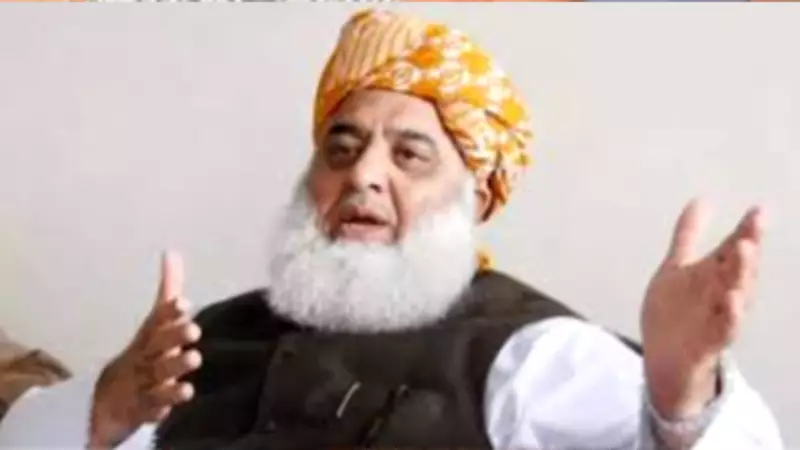
Maulana Fazlur Rehman, the chief of Pakistan's Jamiat Ulema-e-Islam (F) party, delivered a scathing critique on Sunday, targeting the government's handling of militancy and its Afghanistan policy. Speaking at a public gathering in Rawalpindi, Rehman highlighted what he described as a glaring contradiction in Islamabad's approach, questioning how extremist elements continue to cross the border while trade remains blocked.
Border Security and Trade: A Paradoxical Situation
Rehman pointed out the irony in Pakistan's border management. "In all these decades, we never paused to ask why our Afghan policy failed so miserably. Not a single pomegranate or melon can enter Pakistan, yet terrorists keep crossing the border," he said, smiling as he made the remark. He challenged the repeated claims by Pakistani authorities that militants were entering from Afghanistan, stating, "Authorities say terrorists are coming from there. If they are coming, stop them. If they are coming, eliminate them. The Afghan government has never objected to your actions."
Foreign and Economic Policies Labeled as Complete Failures
The JUI-F leader also launched a broadside against Pakistan's broader foreign and economic policies, calling them "complete failures." He argued that Islamabad's diplomatic approach has left the country increasingly isolated on the global stage. "India is our enemy, Afghanistan is our enemy, and even Iran and China are upset with us," Rehman asserted, adding that the public deserves clear answers. "A nation cannot survive when its policies produce only isolation, mistrust and insecurity."

Rehman contended that Pakistan's foreign policy is not being driven by elected governments but by the military establishment. "One general comes and says we will negotiate; another comes and says we will wage war," he remarked, underscoring the inconsistency in strategic decisions.
China-Pakistan Economic Corridor Stalls Amid Declining Trust
Rehman also took aim at the government's management of the China-Pakistan Economic Corridor (CPEC), claiming that this flagship infrastructure project has stalled due to declining Chinese confidence. "CPEC has seen no real progress during this tenure because China no longer trusts us," he said, questioning whether "even a single brick" had moved under the current government. He alleged that Beijing had expected the Pakistan Democratic Movement (PDM) government to stabilize relations and revive projects but remains dissatisfied with the outcomes.
Backdrop of Deadly Islamabad Attack Heightens Tensions
Rehman's remarks come amid heightened tensions following a suicide bombing at a mosque in Islamabad on Friday. The attack killed 69 people and injured more than 170, according to local media reports citing hospital officials. The blast occurred during Friday prayers at Imambargah Qasr-i-Khadijatul Kubra in the Tarlai area.
After Pakistan's Defence Minister Khawaja Asif suggested on social media that preliminary findings pointed to the attacker having travelled to and from Afghanistan, Kabul swiftly rejected the allegation. Afghanistan's Ministry of National Defence termed the claim "irresponsible and baseless" and urged Pakistani authorities to take responsibility for internal security lapses.
The Afghan ministry noted that similar accusations had been made in the past following attacks in Balochistan and other parts of Pakistan, without conclusive evidence being provided. This exchange underscores the ongoing diplomatic friction between the two neighboring nations, adding urgency to Rehman's criticisms of Pakistan's foreign policy and security strategies.