

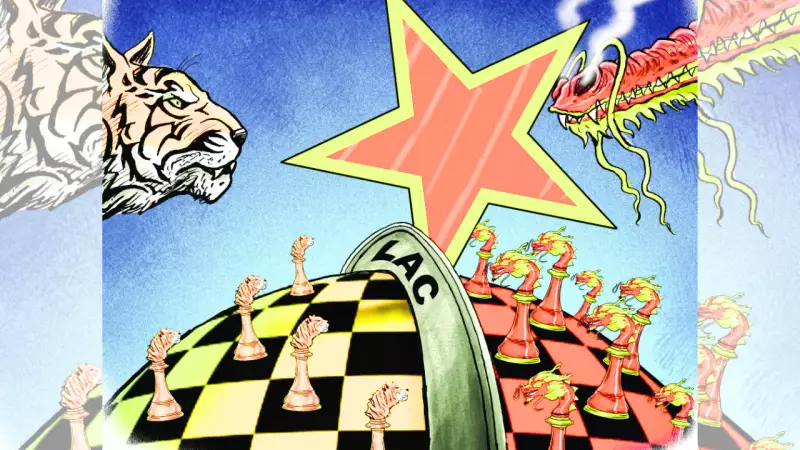
A new report from the United States Department of Defence has sounded the alarm on China's strategic ambitions, placing India's northeastern state of Arunachal Pradesh in the same bracket as Taiwan and disputed maritime territories. According to the annual Pentagon assessment of China's military power, Beijing now actively covets Arunachal as part of its broader national strategy for "great rejuvenation."
Arunachal as a 'Core Interest' and Persistent LAC Tensions
The report, released on Tuesday, states that China's leadership has expanded the term 'core interest' to cover not just Taiwan but also its sovereignty claims in the South China Sea, the Senkaku Islands, and Arunachal Pradesh. This formalises the threat perception for New Delhi. The development follows a pattern of increased Chinese assertiveness along the Line of Actual Control (LAC) since the major incursions by the People's Liberation Army (PLA) in eastern Ladakh in April-May 2020.
While disengagement of troops occurred at the last two immediate face-off sites in Depsang and Demchok in October last year, the Pentagon notes that actual de-escalation on the ground has not followed. For the sixth successive winter, rival armies remain forward deployed all along the 3,488-km LAC. Indian officials confirm that the Tawang sector in Arunachal, which China calls "South Tibet," is now "heavily guarded" with a very high density of troops and weapon systems to deter any potential threat.

China's Dual Strategy: Engage India While Arming Pakistan
The Pentagon analysis suggests a nuanced Chinese approach. It notes that Beijing "probably seeks to capitalise on decreased tensions" along the LAC to stabilise relations with India and prevent a deepening of the US-India partnership, especially after the meeting between Prime Minister Narendra Modi and President Xi Jinping at the BRICS summit in October 2023. However, the report adds a crucial caveat: "India probably remains sceptical of China's actions and motives." It concludes that mutual distrust and other irritants continue to severely limit the bilateral relationship.
Simultaneously, China continues its long-standing policy of militarily bolstering Pakistan to keep India strategically bogged down in South Asia. The report provides concrete details: As of May this year, China had delivered 36 advanced J-10C multirole fighter jets to Pakistan. This is in addition to the earlier supply of four 054A/P multi-role frigates and other platforms. The Times of India had previously reported that Pakistan effectively used these Chinese-origin J-10s, armed with PL-15 air-to-air missiles in a networked combat system, against the Indian Air Force in exercises this May.
Rapid PLA Expansion and Growing Indian Ocean Presence
The Pentagon document extensively details China's rapid and formidable military modernisation across all domains—land, air, sea, space, cyberspace, and electronic warfare—which it states has made the US homeland increasingly vulnerable. Key highlights include the PLA's "massive nuclear expansion," putting it on track to possess over 1,000 warheads by 2030, up from around 600 at present. The navy plans to have six more aircraft carriers by 2035, adding to its existing three.
Another significant concern for India highlighted in the report is China's growing footprint in the Indian Ocean Region (IOR). The Pentagon confirms that the PLA now has an "operational presence" at the Ream naval base in Cambodia. This marks China's second official overseas military base in the wider IOR, after its facility in Djibouti on the Horn of Africa, extending its strategic reach into India's maritime backyard.






