

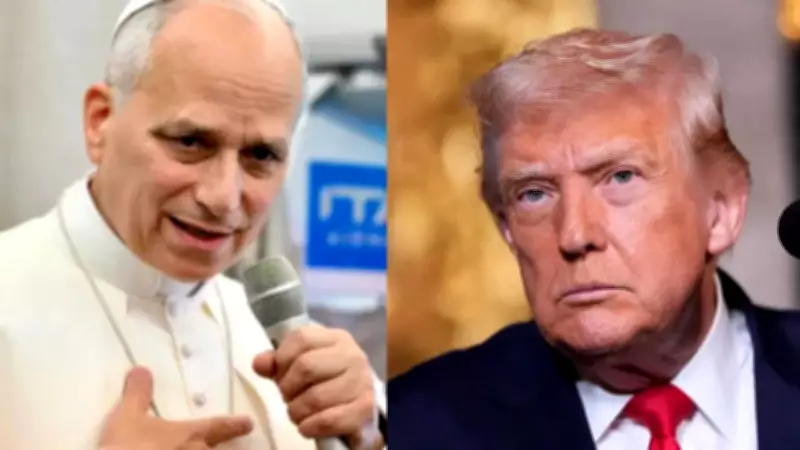
Pope Leo Defies Trump's Criticism, Vows to Continue Peace Advocacy
In a bold statement that has escalated tensions between religious and political leaders, Pope Leo on Monday firmly pushed back against criticism from former US President Donald Trump. Speaking to reporters aboard the papal plane, the pontiff declared he does not fear the Trump administration and will persist in speaking out against war, including the ongoing conflict involving Iran.
"I Have No Fear of the Trump Administration"
Pope Leo made his position clear during the in-flight press conference, stating, "I have no fear of the Trump administration." He defended the Vatican's repeated appeals for peace, emphasizing that these messages are rooted in Christian teaching rather than political maneuvering.
The Pope, who is history's first US-born pontiff, elaborated that his comments were not personally directed at Trump or any specific leader. Instead, they reflect a broader warning against what he termed a "delusion of omnipotence" that he believes is driving global conflicts. He stressed that the Church's fundamental appeal is for peace and reconciliation, not confrontation.

"To put my message on the same plane as what the president has attempted to do here, I think, is not understanding what the message of the Gospel is," Pope Leo said. "And I'm sorry to hear that, but I will continue on what I believe is the mission of the church in the world today."
Trump's Sharp Response to the Pope
Donald Trump responded strongly to the Pope's remarks on Monday, launching a scathing attack via his Truth Social platform. The former president called Pope Leo "weak on crime" and "terrible for foreign policy."
In his post, Trump accused the Pope of focusing on "fear" of his administration while allegedly ignoring what he described as restrictions faced by churches during the Covid-19 pandemic. The former president further criticized Pope Leo for opposing US actions against Iran and other nations.
"Pope Leo is weak on crime, and terrible for foreign policy," Trump wrote, adding that he does not want a Pope who, in his view, supports Iran acquiring nuclear weapons or criticizes US operations abroad.
In subsequent remarks to reporters, Trump repeated his criticism, stating he was "not a big fan" of Pope Leo and describing him as "very liberal." He suggested that the pontiff should focus more on religious duties rather than political matters, warning that such positions could harm the Catholic Church.
Background: Pope's Earlier Peace Appeal
The current exchange follows a strong global appeal for peace that Pope Leo issued on Saturday. During that address, he called on world leaders to end ongoing wars and reject what he described as rising aggression in international politics.
"Enough of the idolatry of self and money! Enough of the display of power! Enough of war!" the Pope declared passionately. "It is time for peace! Sit at the table of dialogue and mediation – not at the table where rearmament is planned and deadly actions are decided."
Pope Leo also warned against using religion to justify violence, noting that even "the holy Name of God... is being dragged into discourses of death." He emphasized that "true strength is shown in serving life," reinforcing his message of peace over conflict.
Broader Implications of the Exchange
This public disagreement between the Pope and former President Trump highlights several significant issues:

- The role of religious leaders in global political discourse
- Differing perspectives on international conflicts, particularly involving Iran
- Tensions between conservative political movements and progressive religious leadership
- The ongoing debate about separation of church and state in international affairs
The exchange comes at a time when global conflicts continue to escalate, with the Iran situation remaining particularly volatile. Pope Leo's insistence on maintaining his peace advocacy despite political criticism underscores the Vatican's traditional role as a moral voice in international affairs, while Trump's response reflects ongoing tensions between certain political factions and religious institutions.
As both figures maintain their positions, this public disagreement may influence how religious and political leaders interact on global issues moving forward, particularly regarding matters of war, peace, and international diplomacy.





