

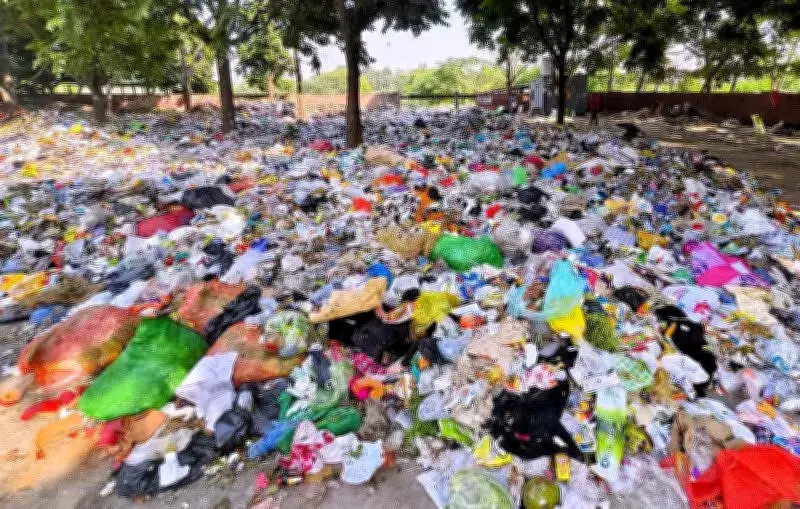
Punjab's Waste Management Compliance Under Fire from National Green Tribunal
The state of Punjab's assertions of adhering to solid and liquid waste management regulations are facing intense scrutiny. An amicus curiae has informed the National Green Tribunal that the state's affidavit is "deficient in substance" and fails to instill confidence regarding environmental outcomes.
Solid Waste Management Gaps Exposed
In a detailed observation report concerning compliance with the Municipal Solid Waste Management Rules of 2016, the amicus curiae criticized Punjab's submission. Despite being extensive in form, the affidavit from the chief secretary does not meet the necessary compliance thresholds.
The report reveals that Punjab's 166 urban local bodies generate approximately 4,008 tonnes per day (TPD) of solid waste. However, only 3,968 TPD is transported, and merely 3,605 TPD is processed. This results in a significant gap of 403 TPD between waste generation and processing. Additionally, there is a 40 TPD gap between generation and transportation, and a 363 TPD gap between transported and processed waste.

Material recovery facilities in the state have a capacity of 2,320 TPD, but they receive only 1,076 TPD of dry waste. Meanwhile, informal waste pickers handle about 388 TPD. To address these issues, the amicus curiae recommended several measures:
- Implement digital tracking through online portals and bulk generator registration.
- Enforce mandatory 100% source segregation with ward-level monitoring and third-party audits.
- Prohibit mixed waste entry into processing plants.
- Create market linkages for compost and submit plant-wise utilisation certificates.
The report also called for comprehensive waste accounting across all urban local bodies, including daily logs and tracking of sanitary and biomedical waste. Strict enforcement of Extended Producer Responsibility was urged, along with identification of bodies contributing to the waste gaps.
Legacy Waste Concerns and Inconsistencies
The observation note highlighted serious concerns about legacy waste management in Punjab. Government records indicate 149 legacy waste sites with a total of 84.09 lakh metric tonnes as of January 2026. Notably, the same figure was reported for January 2024 and January 2025, raising questions about accuracy.
The amicus curiae pointed out inconsistencies, noting that the state claimed remediation of 30.22 lakh metric tonnes in January 2024, 36.24 lakh metric tonnes in January 2025, and 41.75 lakh metric tonnes by September 2025. Yet, the total legacy waste remained unchanged at 84.09 lakh metric tonnes. Recommendations for legacy waste sites include:
- Mandatory safeguards such as groundwater testing and leachate containment.
- Post-remediation land-use certification and monsoon contingency planning.
- Time-bound bio-mining or bioremediation efforts.
- Installation of functional leachate treatment plants.
- Creation of a real-time digital waste tracking system via a centralised portal.
No site should be declared remediated without proper groundwater testing, soil quality reports, and proof of leachate elimination, the report emphasised.
Liquid Waste Management Deficiencies
The report also addressed liquid waste management, revealing that Punjab generates 2,219.91 million litres per day (MLD) of sewage. Treatment utilisation stands at 2,009.50 MLD, leaving a gap of 210.41 MLD. The state operates 162 sewage treatment plants, with six non-complying, 28 under stabilisation, and five under maintenance.
Among 138 urban local bodies, 425 drains carry a flow of 360.89 MLD, while total sewage generation is 1,676.11 MLD. Installed STP capacity is 1,721.50 MLD, with utilisation at 1,475.03 MLD, resulting in a gap of 201.08 MLD. Specific locations like Amritsar, Maur, Rampura Phul, Fazilka, Ferozepur, and Urmar Tanda report STPs operating at full capacity, exacerbating issues.
Treated and untreated discharges flow into drains and water bodies, including the Ghaggar River, Kali Bein, Sutlej, Beas Drain, Beas River, and Sirhind Choe, posing environmental and public health risks. Suggestions to improve liquid waste management include:

- Installation of temporary modular treatment units.
- Interception and diversion systems at major drains until all households are connected.
- Ensuring STPs are located outside highest flood points.
- Bringing all six non-complying STPs up to standard within three months.
Conclusion: Lack of Confidence in Environmental Outcomes
The amicus curiae concluded that Punjab's affidavit does not "inspire confidence" and fails to demonstrate compliance with environmental outcomes, statutory obligations, and judicial directions. The deficiencies are not merely procedural but lead directly to soil and groundwater contamination, air pollution, and public health risks. The report underscores the urgent need for Punjab to address these gaps to safeguard environmental and public health.





