

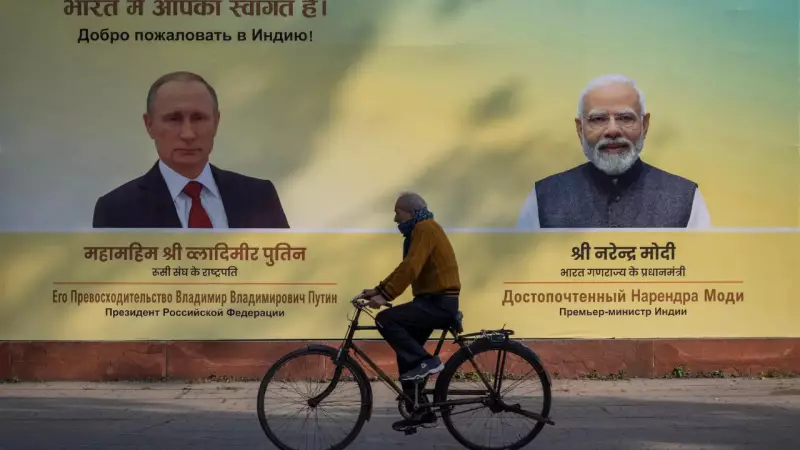
Russian President Vladimir Putin has touched down in New Delhi for a critical two-day state visit, marking his first trip to India since the onset of the Ukraine war in February 2022. The high-stakes summit with Prime Minister Narendra Modi comes at a time when Moscow, grappling with new US sanctions and deepening global isolation, is leaning heavily on its historic partner to maintain economic and strategic relevance.
The Oil Lifeline and the Sanctions Squeeze
The core of the engagement revolves around energy. India's imports of Russian crude have skyrocketed from a mere 2% of its total purchases in early 2022 to between 35% and 40%, briefly making it Moscow's top customer ahead of China. This discounted oil has been a boon for India, helping control inflation and boost refining profits.
However, this crucial flow is now under threat. Fresh US sanctions targeting Russian giants like Rosneft and Lukoil have spooked Indian refiners, leading to a drop in imports that are projected to hit a three-year low in December. Kremlin spokesperson Dmitry Peskov has termed this a "temporary disruption," promising "sophisticated" solutions to keep the energy ties intact.

The US pressure is palpable. American lawmakers have accused India of acting as a "laundromat" for Russian oil, refining and re-exporting it globally. Washington is actively pushing New Delhi to scale back these purchases and turn to American energy suppliers instead.
Trade Boom, Imbalance, and Strategic Asks
Bilateral trade has ballooned to an unprecedented $68.7 billion in the 2024–25 financial year, a dramatic jump from $13 billion in 2021. But this boom is lopsided. A staggering $63.8 billion constitutes Indian imports of Russian oil, fertilizers, and coal, while exports to Russia languish below $5 billion.
This imbalance creates both diplomatic and financial headaches, including frozen payments due to sanctioned banking channels. India is pushing for robust rupee-rouble settlement mechanisms to bypass the dollar-dominated SWIFT system, but progress remains slow. Peskov acknowledged the issue, stating Russia is looking to buy more Indian pharmaceuticals, food, and machinery to rebalance trade.
Beyond trade, Putin seeks assurances that India will remain open to Russian arms and not pivot fully to the West. For Modi, the demands include reliable energy supplies, clarity on defense cooperation timelines, and crucial geopolitical assurances regarding Russia's deepening alliance with China.
Defense Ties: Evolving but Enduring
Russia's dominance as India's primary arms supplier is eroding but remains significant. Its share of India's defense imports has fallen from 70% a decade ago to about 36% today, as India diversifies with French Rafales, US drones, and domestic "Make in India" projects.
Nevertheless, Moscow is far from sidelined. This year, India inked a $248 million deal to upgrade its Russian T-72 tank engines. Negotiations are ongoing for advanced S-400 air defense systems and fifth-generation Su-57 fighters. Joint ventures like the BrahMos missile and AK-203 rifle production continue to be partnership cornerstones. A key strategic signal is the new Reciprocal Exchange of Logistics Agreement (RELOS), granting mutual access to military bases.
The Diplomatic Tightrope and What's Next
India is meticulously walking a diplomatic tightrope, balancing its long-standing ties with Moscow against its growing strategic and economic convergence with Washington. The shadow of US politics looms large, with former President Donald Trump having imposed 50% tariffs on Indian goods, partly citing its Russian oil imports.
The summit is expected to yield outcomes on defense contracts, updates on rupee-rouble trade frameworks, and a joint statement reaffirming a "strategic partnership" in a multipolar world. For Russia, the visit is about staying visible and proving it retains global agency. For India, it is a stress test of its doctrine of strategic autonomy—the art of being everyone's partner without becoming anyone's pawn.

As one analyst noted, the summit provides Delhi with a vital third option, offering bargaining leverage with both Beijing and Washington. Every announcement from New Delhi will be scrutinized in Western capitals, potentially inviting further scrutiny. The bottom line: this is transactional diplomacy at its most complex, where historic friendship meets contemporary realpolitik.





