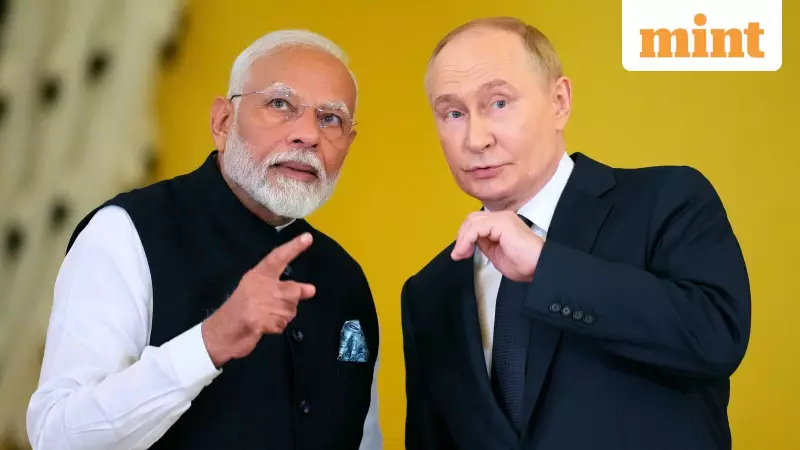
Russian President Vladimir Putin has arrived in New Delhi for a high-stakes, two-day summit, marking his first trip to India since the onset of the Ukraine conflict. The visit, commencing on 4 December 2025, unfolds against a complex backdrop of intense US pressure on India's energy imports and critical discussions on defence cooperation and a lopsided trade relationship.
The Energy Tightrope: US Pressure and Shifting Crude Flows
The core of the bilateral partnership has dramatically shifted to energy since 2022, with Russia becoming India's top crude supplier. This relationship was built on the foundation of steep discounts offered by Moscow, catapulting its share in India's oil basket from a mere 2% before 2022 to over 35%. However, this crucial lifeline is under severe strain.
The United States, under President Donald Trump, has imposed an additional 25% tariff on Indian goods as a penalty for purchasing Russian oil, raising India's total tariff burden to a significant 50%. Compounding this pressure, fresh US sanctions targeting Russia's two largest oil companies, Rosneft and Lukoil, which took effect on 21 November
Analysts from Kpler noted in a 25 November report that India's imports of Russian crude are expected to see a temporary but meaningful decline following the new sanctions. The report states that India will likely accelerate its diversification efforts, turning to suppliers in the Middle East, the US, Latin America, and West Africa. However, a complete halt is improbable, with imports expected to continue via non-sanctioned Russian entities and "less transparent means." The surge in cheap oil has come at a cost, blowing up India's trade deficit with Russia to an alarming $59 billion in the last fiscal year (FY25). India's imports from Russia skyrocketed to $63.8 billion in FY25, a more than sixfold increase from $10 million in FY22. In stark contrast, Indian exports to Russia have stagnated, reaching only $4.9 billion in FY25, up modestly from $3.3 billion in FY22. Petroleum products dominate imports, accounting for 84% of the total, followed by coal, vegetable oil, and fertilizers. India's export basket remains narrow, focused on pharmaceuticals, machinery, and computer hardware. Narrowing this gap by identifying and expanding export opportunities is a top priority for New Delhi during the summit talks. While energy now drives the relationship, defence remains a historic pillar, albeit one where Russia's dominance is waning. Russia's share of India's defence imports has fallen from nearly 90% at the century's start to around 40% now, as India diversifies its sources to include France and Israel. Putin's visit is expected to feature discussions on India's potential purchase of additional S-400 air defence systems and the advanced Su-57 fifth-generation stealth fighter jets, as confirmed by the Kremlin. An emerging and unexpected dimension of the relationship is labour migration. Facing a severe worker shortage exacerbated by the war, Russia has significantly increased its quota for workers from visa-requiring countries. Indians have become the second-largest group among such workers, with permits issued jumping from 5,480 in 2021 to 36,208 in 2024. These workers are primarily employed in construction, textiles, and logistics, creating a new human bridge between the two nations. Putin's visit, therefore, represents a critical juncture. India must navigate its energy security needs under the shadow of US sanctions, rebalance a deeply skewed economic relationship, and manage a strategic defence partnership while exploring new areas of cooperation like labour, all in a single diplomatic engagement.
Addressing the Massive Trade Imbalance
Defence, Migration, and the Future of the Partnership