

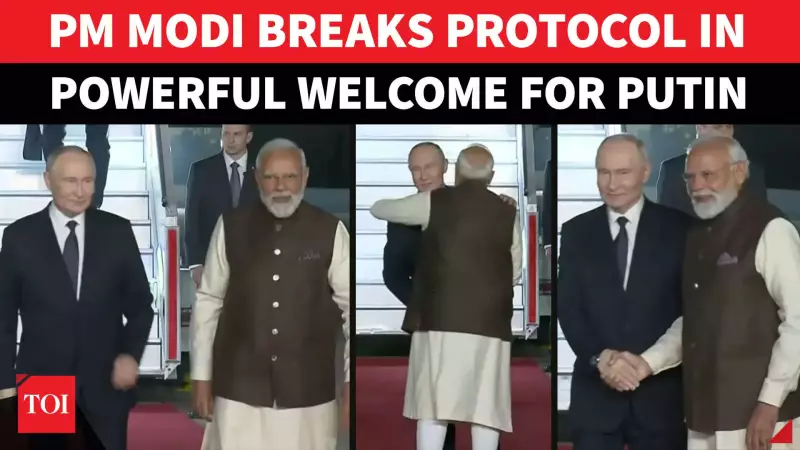
In a powerful display of enduring friendship, Russian President Vladimir Putin touched down in New Delhi on Thursday night, commencing a tightly packed 27-hour state visit. This high-profile trip, the first in four years, arrives at a critical juncture for the nearly eight-decade-old strategic partnership between India and Russia, as global geopolitical fault lines deepen.
A Personal Welcome and Rare Diplomatic Gesture
Breaking from standard protocol, Prime Minister Narendra Modi personally received President Putin at New Delhi's Palam Airport. The leaders shared a warm hug, a rare and symbolic diplomatic gesture that immediately highlighted the personal chemistry and historical warmth defining bilateral ties. This set the tone for the visit ahead of the 23rd India-Russia Annual Summit scheduled for Friday.
Following the arrival, PM Modi hosted President Putin for a private dinner, offering an informal setting to discuss key issues before the formal summit negotiations. The visit's agenda is both wide-ranging and strategically significant, designed to fortify the partnership against external pressures.

Agenda: Defence, Energy, and Beating Sanctions
The summit talks at Hyderabad House are expected to focus on several pivotal areas of cooperation. Boosting defence ties remains at the forefront, with discussions likely centred on the potential procurement of additional regiments of the S-400 Triumf air defence missile systems. A significant item on the table is a possible Russian offer of its advanced fifth-generation Su-57 fighter jets to the Indian Air Force.
Beyond military hardware, the two nations aim to insulate their bilateral trade from the impact of Western sanctions. This involves creating robust payment mechanisms and exploring trade in national currencies. Other critical areas for discussion include:
- Expanding cooperation in the field of small modular reactors (SMRs) for civil nuclear energy.
- Ensuring stable energy security, particularly regarding Russian oil supplies to India.
- Collaboration on fertilisers to safeguard India's agricultural sector.
- Enhancing frameworks for labour mobility between the two countries.
The timing of the visit is particularly sensitive. India-U.S. relations are currently facing strain over issues like American tariffs and New Delhi's continued purchase of Russian crude oil. This summit allows India to reaffirm the strategic autonomy of its foreign policy while securing crucial national interests.
A Ceremonial and Symbolic Itinerary
President Putin's short but significant visit is packed with official engagements that blend ceremony with substance. On Friday, he will receive a formal ceremonial welcome at Rashtrapati Bhavan, the presidential palace. In a tribute to Mahatma Gandhi, the Russian leader will also pay his respects at Rajghat.
The core diplomatic discussions will take place during the summit talks at Hyderabad House. A notable cultural-diplomatic event will be the launch of a new Indian channel of the Russian state broadcaster. The visit will conclude with President Putin attending a state banquet hosted by President Droupadi Murmu before his departure on Friday night.
This visit underscores India's delicate and deliberate balancing act on the world stage. While nurturing its key partnerships with Western nations, New Delhi continues to invest deeply in its time-tested strategic alignment with Moscow, especially in areas critical to its defence and energy needs. The warm hug at the airport was more than just a greeting; it was a statement of intent for a relationship navigating a complex new world order.






