

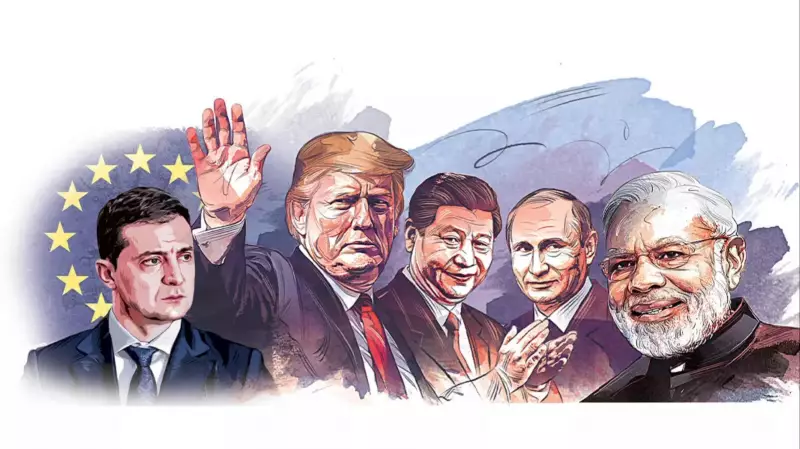
Russian President Vladimir Putin has arrived in India for a crucial bilateral summit, marking his first visit to the country in four years. This significant diplomatic engagement, the 23rd India-Russia annual summit, comes after the longest interruption in the dialogue process since its inception in the year 2000. The extended gap stands in stark contrast to the frequent high-level interactions India has maintained with Western leaders and Chinese President Xi Jinping during the same period.
A Summit Defined by Its Delay
The notable four-year hiatus in the India-Russia summitry is more than a scheduling anomaly; it is a reflection of the profound geopolitical tremors reshaping global alliances. While Indian Prime Minister Narendra Modi has hosted and visited American and European counterparts with regularity, and even engaged with China's Xi despite ongoing border tensions, the rhythm with Moscow was disrupted. This break underscores the complex position India navigates as the war in Ukraine continues to redraw the international order.
From New Delhi's perspective, the contrast is indeed jarring. The West remains actively engaged with India, a strategic partner in the Indo-Pacific. Simultaneously, Western nations have imposed unprecedented isolation on Russia following its invasion of Ukraine. India's challenge has been to preserve its time-tested partnership with Moscow while deepening ties with the West, all without formally joining any camp. The resumption of the summit suggests both sides are keen to reaffirm the relationship, but its context is undeniably altered.

The Geopolitical Balancing Act
Analyst Pankaj Saran, writing on December 04, 2025, framed the India-Russia bilateral relationship as one critical piece in a vast and complex geopolitical game. The playing field is constantly shifting, with major powers like the US, China, and Russia pursuing their own autonomous strategies. For India, near-term foreign policy options are intricately linked to global events, particularly the resolution of the conflict in Ukraine. A potential end to the war, possibly influenced by the political landscape in the United States, could significantly recalibrate options for New Delhi.
An observer might find irony in the West's diplomatic posture. As Saran pointed out, Western capitals have been nonchalant about high-level engagements with China, a nation that from India's viewpoint has committed several infractions—including territorial expansion, militarisation, and hybrid warfare along the Line of Actual Control. Yet, these are the very actions Russia is broadly accused of on the global stage. This dichotomy highlights the pragmatic and often contradictory nature of international relations, where strategic interests frequently override consistency in principle.
Looking Ahead: An Autonomous Path
The summit's agenda is expected to cover traditional pillars of cooperation—defence, energy, and trade—but with a renewed focus on navigating financial sanctions and maintaining economic channels. The outcome will be closely watched in world capitals as a barometer of India's strategic autonomy. The meeting reaffirms that despite pressure, India continues to engage with all major powers on its own terms, prioritising national interest above bloc politics.
Ultimately, Putin's visit after four years is a powerful symbol of continuity in a relationship that India values for historical, strategic, and material reasons. However, it also occurs on shifting grounds. The future trajectory of this partnership will depend not just on bilateral goodwill, but also on how the larger geopolitical game between the US, Europe, China, and Russia evolves, and importantly, on whether and how the war in Ukraine concludes.






