

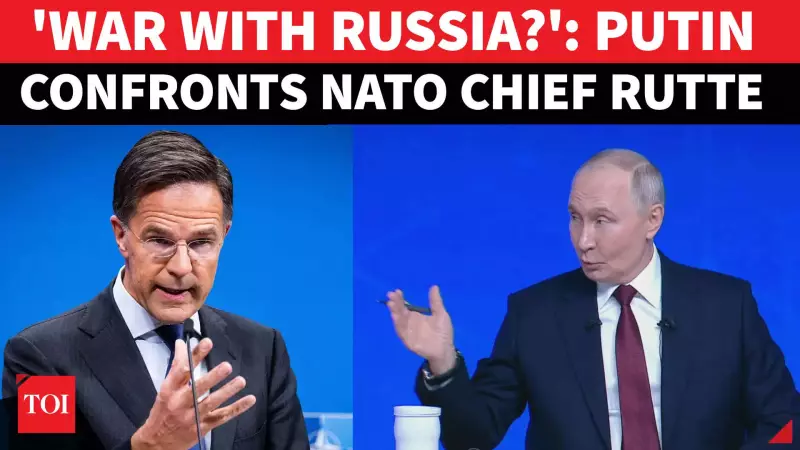
In a rare and direct verbal assault, Russian President Vladimir Putin has publicly lambasted NATO Secretary General Mark Rutte, sharply questioning his ability to read. The confrontation occurred during Putin's annual year-end press conference in Moscow on Friday, December 20, 2025.
The Spark: Rutte's Call to Arms
The Russian leader's ire was a direct response to comments made by the NATO chief just over a week earlier. On December 11, 2025, Mark Rutte, speaking at a forum in Germany, issued a stark warning to European nations. He urged them to prepare for a potential military confrontation with Russia, drawing a grim parallel to the wars experienced by their grandfathers and great-grandfathers.
Putin used his high-profile platform to deliver a pointed rebuttal, framing Rutte's statements as not just provocative but fundamentally ignorant of Russia's stated position. The core of Putin's argument rested on Moscow's long-standing diplomatic outreach to the West.

Putin's Core Counter-Argument
President Putin emphasised that Russia has repeatedly expressed its readiness to provide written guarantees that it has no intention of attacking NATO or European Union member states. "Moscow has repeatedly expressed its readiness - including in writing - to record guarantees that Russia has no intention of attacking NATO countries or the European Union," he stated, highlighting what he sees as a deliberate oversight by Western leadership.
His rhetorical question, "Can you read at all?" aimed directly at Rutte, was meant to underscore his frustration. Putin implied that the NATO Secretary General was either unaware of or willfully ignoring these official Russian proposals, choosing instead a narrative of inevitable conflict.
Broader Implications for Global Security
This public dressing-down is significant for several reasons. Firstly, it represents a departure from diplomatic nuance, marking one of Putin's most personal and publicly scornful attacks on a sitting NATO chief. The language cuts through typical diplomatic jargon, signalling heightened tensions.
Secondly, the exchange lays bare the deep and seemingly unbridgeable rift in trust between Moscow and the NATO alliance. While Russia offers assurances on paper, the West, led by figures like Rutte, appears to base its strategy on Russia's actions, particularly its ongoing war in Ukraine, viewing verbal guarantees with deep scepticism.
The incident sets a confrontational tone for Russia-NATO relations as the world moves into 2026. It effectively shuts down avenues for de-escalation through public discourse, hardening positions on both sides. For European nations, Rutte's initial warning and Putin's furious response create a dual pressure: to heed the call for military preparedness while navigating the volatile rhetoric from the Kremlin.
Ultimately, this war of words between Putin and Rutte is more than a personal spat; it is a microcosm of the current dangerous stalemate in Euro-Atlantic security, where dialogue has broken down and mutual accusations of bad faith dominate the landscape.






