

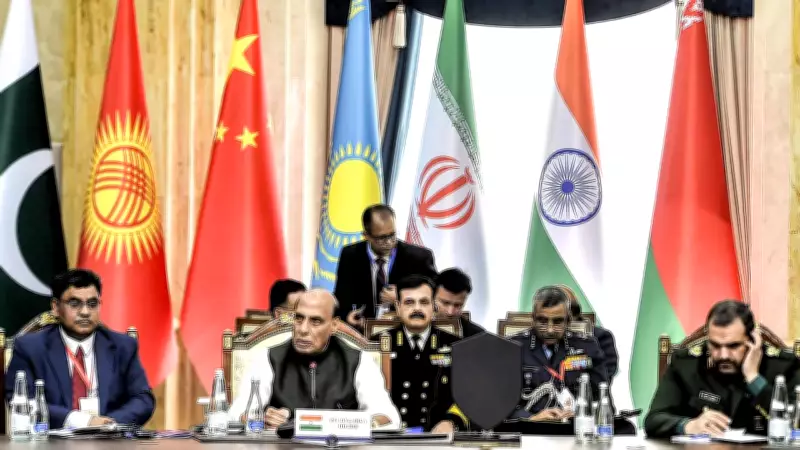
Defence Minister Rajnath Singh on Tuesday addressed the Shanghai Cooperation Organisation (SCO) defence ministers' meeting in Bishkek, stressing the urgent need for a collective and uncompromising approach to tackle the “evils” of terrorism, separatism and extremism by dismantling safe havens and rejecting any political justification for such acts.
Operation Sindoor sends a strong message
“Operation Sindoor demonstrated India's firm resolve that terrorism epicentres are no longer immune to justifiable punishment,” the defence minister said while addressing the SCO gathering. He called on member-states to eliminate double standards in the global fight against terror, asserting that there is no place for ambiguity when dealing with those who provide safe havens to terrorists.
“We must not lose sight of state-sponsored cross-border terrorism which attacks the very sovereignty of a nation state,” Rajnath stated, adding that the SCO should not hesitate in seeking appropriate action against those who abet and shelter such elements.

Remembering Pahalgam victims
Recalling the victims of the Pahalgam terror attack on April 22 last year, he said “no grievance, real or supposed, can become an excuse for terrorism and humanitarian loss”. He further emphasised that “terrorism has no nationality and no theology”, urging the forum to act as a “consistent guardian of international standards”.
“By tackling terrorism, separatism, and extremism without exception, we transform regional security from a challenge into a cornerstone for peace and prosperity,” Rajnath stressed.
Call for dialogue over war
Touching upon global security, the defence minister noted that the international community is facing a reality check due to increasing unilateralism. He argued that the current crisis stems from a tendency to question the “established rule-based world order” rather than a lack of an existing framework.
“We need an order where differences do not become disputes and disputes don't precede disasters,” he said. Urging a shift away from aggression within this influential framework, the defence minister called for a renewed commitment to the peaceful resolution of conflicts.
“We should continue to follow the path of dialogue and diplomacy and not of unrelenting force. We should not allow it to become an era of violence and war, but an era of peace and prosperity,” he said, while invoking the ethical framework of Mahatma Gandhi.
SCO's role in global stability
Rajnath emphasised the collective responsibility of the member nations in maintaining global equilibrium. “Since SCO represents a significant section of the world population, we have a responsibility to ensure peace and stability not only in our region, but in the world as a whole,” he said. The SCO currently includes India, Russia, China, Pakistan, Kazakhstan, Kyrgyzstan, Tajikistan, Uzbekistan, Iran, and Belarus.
Reiterating India's commitment to the SCO's mandate through the philosophy of “Vasudhaiva Kutumbakam”, the defence minister said India believes the organisation possesses the strength to contribute significantly to regional stability. He called for “greater cooperation and mutual trust among SCO members based on equality and mutual respect” to address shared challenges without exception.
Originally founded in 2001 by Russia, China, and Central Asian states, SCO has grown into a major regional powerhouse over the last 20 years. Since becoming a full member in 2017, India has played a pivotal role in the bloc, notably assuming the rotating chairmanship in 2023.






