

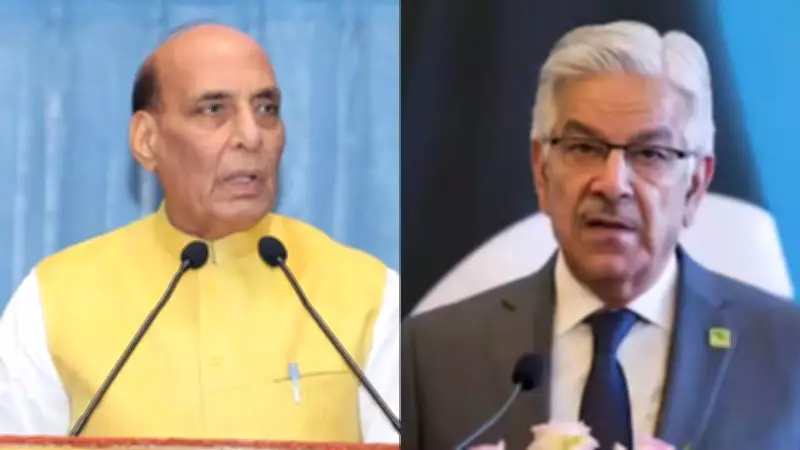
Rajnath Singh Issues Stern Warning to Pakistan Over Provocative Kolkata Remarks
Defence Minister Rajnath Singh delivered a sharp rebuke to Pakistan on Tuesday, condemning recent threatening statements made by Pakistan's Defence Minister Khawaja Asif regarding potential strikes on Kolkata. Singh characterized Asif's comments as deliberately provocative and cautioned Islamabad against repeating historical errors that have previously resulted in severe consequences for Pakistan.
Historical Parallels Drawn to 1971 Partition
"Pakistan's Defence Minister should not have issued such a provocative statement," Singh declared during his response. "Fifty-five years ago, they faced the consequences when Pakistan was divided into two separate nations. If they attempt to cast an eye on Bengal this time, only divine providence knows how many fragments Pakistan might be divided into."
This forceful warning references the 1971 Bangladesh Liberation War, which resulted in Pakistan's eastern wing becoming the independent nation of Bangladesh—a significant geopolitical event that reshaped South Asian dynamics.

Background of Pakistan's Threatening Statements
The exchange follows Asif's recent address in Sialkot, where he explicitly warned that Pakistan could target Kolkata in response to any "future misadventure" by India. "If India attempts another false-flag operation, then, God willing, we will take it to Kolkata," Asif stated during his speech.
Additionally, the Pakistani defence minister alleged without presenting evidence that New Delhi might be planning a "false-flag operation" to implicate Islamabad—a claim that Indian officials have consistently denied as baseless propaganda.
Ongoing Tensions and Military Posturing
Relations between the neighboring nuclear powers have remained strained since the devastating Pahalgam terrorist attack on April 22 last year, which claimed the lives of 26 civilians, predominantly tourists. Indian authorities have attributed this assault to Pakistan-backed terrorist elements.
The aftermath witnessed a brief but intense military confrontation between May 7 and 10, 2023, before hostilities temporarily subsided following Pakistan's ceasefire request. India accepted this ceasefire while maintaining that its military response under Operation Sindoor had merely been paused, not terminated.
New Delhi has repeatedly asserted that it will not differentiate between terrorist organizations and Pakistan's military leadership when formulating responses to cross-border threats—a policy stance that underscores the seriousness with which India views security challenges from its western neighbor.
Escalating Rhetoric from Pakistani Officials
Earlier, Asif had described Pakistan's potential response to any Indian action as "swift, calibrated and decisive," reacting directly to Singh's previous warning that any future "misadventure" would invite "unprecedented and decisive" retaliation from Indian forces.
This diplomatic friction has been further amplified by comments from former Pakistani high commissioner to India Abdul Basit, who suggested that Islamabad could target major Indian metropolitan centers including Mumbai and New Delhi if Pakistan's nuclear arsenal faced threats. Basit argued that under such circumstances, India would become the "next best option" for retaliatory measures.
"If someone casts an evil eye on us, we will strike Mumbai and New Delhi without hesitation," Basit added during his remarks, contributing to the escalating war of words between the two nations.
Strategic Implications and Regional Stability
The latest exchange highlights the fragile state of India-Pakistan relations and the potential for rhetorical escalations to translate into actual military confrontations. Both nations possess nuclear capabilities, making diplomatic restraint and clear communication channels critically important for regional stability.
Indian defence analysts note that Singh's reference to Pakistan's 1971 division serves as a powerful historical reminder of the consequences of military miscalculations, while simultaneously reinforcing India's commitment to protecting its territorial integrity against external threats.






