

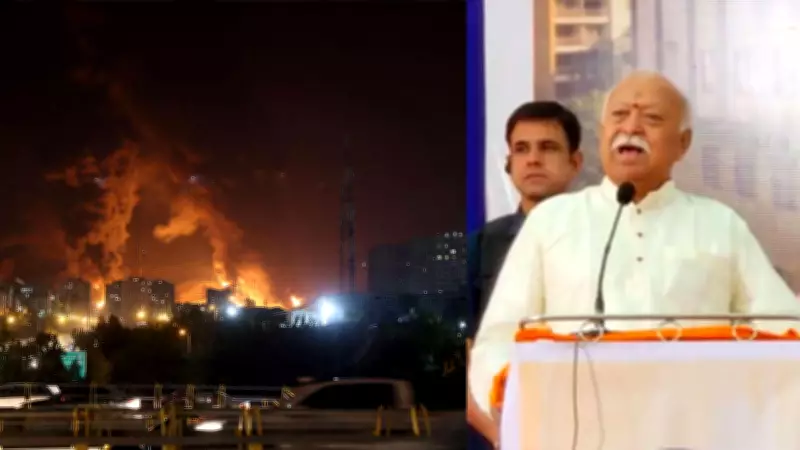
RSS Chief Mohan Bhagwat Declares World Views India as Crucial Peacemaker in Global Conflicts
In a powerful address delivered in Nagpur, Rashtriya Swayamsevak Sangh (RSS) chief Mohan Bhagwat has made a significant statement regarding India's potential role in resolving international wars. Speaking to a gathering, Bhagwat emphasized that there is a growing global consensus that only India possesses the capability to halt ongoing conflicts and foster peace worldwide.
Global Recognition of India's Peace-Oriented Approach
Bhagwat pointed to increasing international acknowledgment of India's unique approach to global affairs, which prioritizes harmony and dialogue over aggression. He argued that while many nations engage in power politics driven by ego, dominance, and narrow self-interests, India follows what he termed "the law of humanity." This philosophical foundation, according to Bhagwat, positions India uniquely as a stabilizing force in a world increasingly divided by conflict.
Civilizational Ethos as Alternative to Conflict-Driven Systems
The RSS chief highlighted India's ancient civilizational ethos, which is rooted in principles of unity, dharma (righteous duty), and collective responsibility. He suggested that this cultural and philosophical heritage offers a viable alternative to the conflict-driven systems that currently dominate global politics. "True solutions to wars lie not in military might or political maneuvering," Bhagwat stated, "but in fostering harmony and recognizing our shared humanity."

Timely Remarks Amid Escalating Global Tensions
Bhagwat's remarks come at a particularly sensitive time in international relations, with escalating tensions in West Asia and other regions. His statement reinforces India's emerging image as a nation advocating for restraint, dialogue, and peaceful resolution of disputes. The message is clear: as traditional power structures falter in addressing global conflicts, India could emerge as the crucial mediator and peacemaker that the world needs.
Contrast with Conventional Power Politics
Drawing a sharp contrast with conventional approaches to international relations, Bhagwat criticized what he described as ego-driven politics that prioritize national dominance over global welfare. He positioned India's approach as fundamentally different—one that seeks to balance national interests with global responsibility. This perspective, he suggested, is why the international community is increasingly looking toward India for leadership in conflict resolution.
The RSS chief's intervention adds to ongoing discussions about India's evolving role on the world stage, particularly as it navigates complex geopolitical challenges while maintaining its traditional commitment to non-violence and dialogue.






