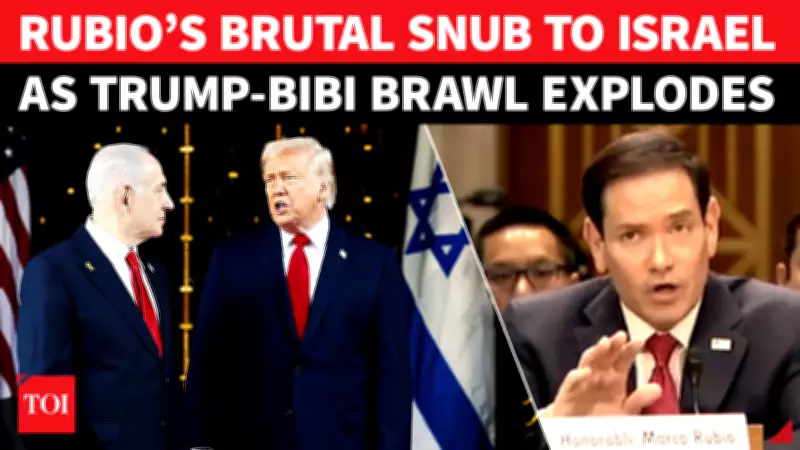
The public facade of an unbreakable alliance between the United States and Israel has been completely shattered on Capitol Hill. In a stunning Senate hearing, Secretary of State Marco Rubio delivered a cold-blooded snub to Jerusalem, flatly stating that Israel has no territorial claims in Lebanon. This diplomatic cover-up matches a volcanic explosion behind closed doors, where President Trump reportedly used severe profanity during a heated phone call with Prime Minister Benjamin Netanyahu, forcing Israeli troops to halt their Beirut offensive.
Diplomatic Earthquake in Washington
The hearing, which was expected to be a routine discussion on Middle East policy, took a dramatic turn when Rubio was questioned about Israel's recent military operations in Lebanon. In a clear break from previous U.S. policy, Rubio declared that Israel's actions were not justified by any territorial ambitions, effectively undermining the Israeli government's stated security objectives. This statement has sent shockwaves through diplomatic circles, with many interpreting it as a signal that Washington is willing to sacrifice Israel's military goals to secure a legacy mega-deal with Iran.
The Volcanic Phone Call
According to sources familiar with the conversation, President Trump's phone call with Netanyahu was characterized by severe profanity and an ultimatum: halt the offensive immediately or face consequences. The call reportedly lasted over 30 minutes, with Trump expressing frustration over the escalating conflict and its potential to derail negotiations with Tehran. The pressure was so intense that Israeli forces were ordered to stand down within hours, much to the dismay of military commanders who had been planning a major push into Hezbollah strongholds.

Implications for the Region
The sudden ceasefire has created a vacuum that Hezbollah may exploit. Analysts warn that the halt in operations could allow the militant group to regroup and rearm, potentially leading to a more protracted conflict in the future. Meanwhile, the Trump administration appears to be doubling down on its pursuit of a comprehensive deal with Iran, which would include sanctions relief and nuclear restrictions. Critics argue that this prioritization comes at the expense of Israel's security and undermines the credibility of U.S. alliances in the region.
Reactions from Jerusalem
In Israel, the news has been met with widespread anger and disbelief. Opposition leaders have accused Netanyahu of buckling under U.S. pressure and failing to protect the nation's interests. Protests have erupted outside the Prime Minister's residence, with demonstrators waving signs that read "Netanyahu: Trump's Puppet" and "Don't Sell Out Israel." The government has remained largely silent, but behind-the-scenes efforts are underway to salvage the diplomatic relationship with Washington.
The Iran Factor
At the heart of this diplomatic rift is the proposed Iran deal, which Trump has championed as a cornerstone of his foreign policy legacy. The deal, which is still being negotiated, would see Iran limit its nuclear program in exchange for the lifting of economic sanctions. However, Israel views Iran as an existential threat and has consistently opposed any agreement that does not dismantle Iran's nuclear infrastructure. The current crisis highlights the growing tension between the two allies over how to handle the Iranian threat.
As the situation continues to unfold, all eyes are on Washington and Jerusalem. Will the alliance survive this test, or has the unbreakable bond been permanently fractured? The next few weeks will be critical in determining the future of U.S.-Israel relations and the balance of power in the Middle East.