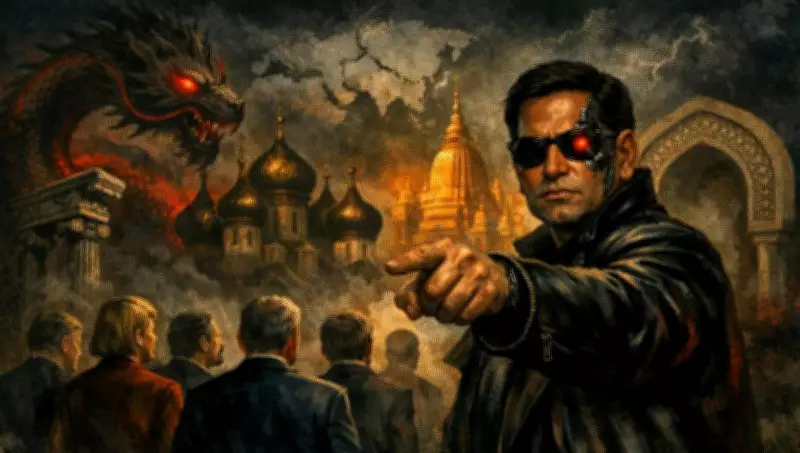
From Satirical Skits to Strategic Warnings: Europe's Fate in American Hands
A humorous BBC sketch titled The Treaty of Westphalia playfully imagines European powers dividing the continent, mocking each other's culinary habits and pondering a common currency. In the skit, Great Britain dismissively focuses on its American colony, with a negotiator quipping about its value being limited to "tobacco, potatoes, and high-grade narcotics"—a jab directed at France, portrayed by Hugh Laurie. This joke gains ironic layers as Laurie later played Dr. Gregory House, a drug-addicted detective, and Britain's colony eventually dictates Europe's destiny centuries later.
The Shift from Monroe to "Donroe": Trump's Impact on Transatlantic Ties
Since 1945, Western Europe has grown increasingly reliant on America, but the Monroe Doctrine has evolved into what some call the "Donroe Doctrine" under Donald Trump, characterized by unilateral actions. Returning from political exile—a feat even Napoleon couldn't achieve—Trump has treated Europe with the same disregard Europe once showed the world, stripping away impunity. Historically, Europeans used civilizational rhetoric to justify violence, framing land grabs as Crusades and colonialism as a "White Man's Burden." Trump, largely indifferent to such linguistic niceties, leaves diplomacy to his administration, notably Marco Rubio.
Marco Rubio's Munich Address: A Civilizational Wake-Up Call
At the Munich Security Conference, Rubio, serving as Secretary of State and National Security Advisor, adopted a conciliatory yet firm tone. He challenged the post-Cold War belief in liberal democracy's inevitable triumph, often associated with Francis Fukuyama's "End of History" thesis. Instead, Rubio echoed Samuel Huntington's "Clash of Civilizations," highlighting how rising powers like China, Russia, and India are asserting civilizational identities rather than adopting Western models.

Rubio argued that Western assumptions about trade replacing geopolitics and international institutions overriding sovereignty failed to account for these civilizational forces. He reminded Europe of its cultural legacy, citing Beethoven and the Beatles, while blaming its struggles on deindustrialization, mass migration, climate orthodoxy, and overreliance on global bodies. Notably, he avoided terms like "wokeism," focusing on a call to action: "Acting together in this way, we will not just help recover a sane foreign policy. It will restore to us a clearer sense of ourselves."
Europe's Response: Public Praise and Private Concerns
European leaders publicly welcomed Rubio's speech as a thaw after last year's blunt address by JD Vance. Privately, however, officials decoded the subtext. One EU source told Politico it was "a milder way of telling us that the time of unicorns riding bicycles across rainbows laced with tofu and almond milk is over." The underlying message was clear: align with America or face consequences. NATO Secretary General Mark Rutte had previously joked about Trump as "daddy," and Rubio's rhetoric reinforced this dynamic, politely asserting U.S. dominance.
The Ultimatum: Join or Fade into Irrelevance
Rubio's speech framed Europe's choice starkly. By invoking civilizational erasure, he warned that without U.S. partnership, Europe risks becoming irrelevant in a world no longer centered on its conflicts. The Treaty of Westphalia era, when Europe could challenge globally, is long gone. Rubio's approach, though more diplomatic than Trump's, carried the same essence: a Terminator-esque "Come with me if you want to live" adapted to "come with us or face civilizational erasure." This ultimatum underscores a shifting global order where Europe must decide its role—either as a partner in America's vision or a fading power.