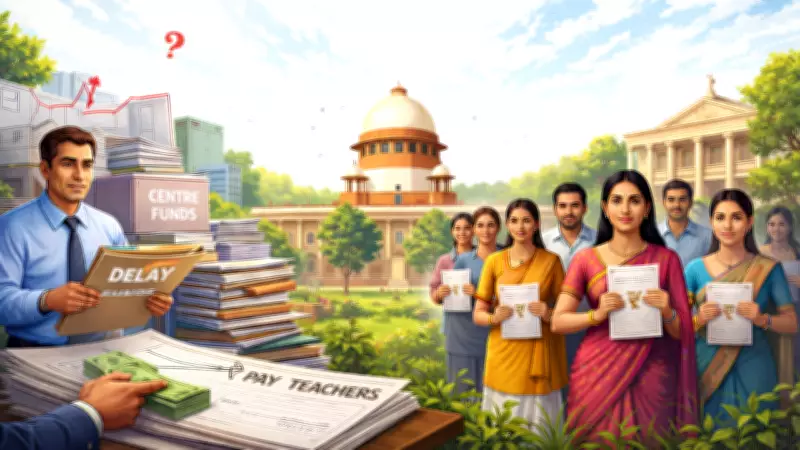
Supreme Court Mandates Rs 17,000 Monthly Honorarium for UP's Part-Time Instructors, Condemns Decade of Stagnant Wages
For over a decade, thousands of so-called 'part-time' instructors in Uttar Pradesh's upper primary schools have been trapped in a stark paradox. While the state's commitment to education grows increasingly vocal, the individuals tasked with delivering this promise have been confined to a fixed monthly honorarium of Rs 7,000, with virtually no upward movement. Appointed around 2013–14 under the erstwhile Sarva Shiksha Abhiyan, now integrated into Samagra Shiksha, these educators were bound by a restrictive condition prohibiting them from taking any other employment, effectively locking them into a single, meager income source.
A Decade-Long 'Temporary' Post That Became Permanent
The dispute originated from a 2013 Government Order in Uttar Pradesh, which appointed contractual instructors for upper primary schools (Classes VI–VIII) to teach physical education, art education, and work education. These appointments, advertised in February 2013, were based on 11-month contracts renewed annually. A critical clause in these agreements explicitly barred instructors from engaging in any other full-time or part-time work, rendering the 'part-time' label misleading and restrictive.
Writ petitions eventually reached the Allahabad High Court. A Single Judge directed payment of Rs 17,000 per month starting March 2017, but the Division Bench later limited this entitlement to the 2017–18 period alone. Both parties appealed—the instructors arguing the hike should not be revoked, and the state contending it should not bear the cost if the central government failed to release its share of funds.

Supreme Court's Landmark Ruling: Pay First, Recover Later
In a decisive judgement, the Supreme Court has cut through bureaucratic delays and intergovernmental blame-shifting. The Court has unequivocally held that a state cannot justify low or withheld honorariums by citing the Centre's failure to disburse funds. Invoking Section 7(5) of the Right to Education (RTE) Act, which places overriding responsibility on state governments to provide implementation funds, the Court emphasized a clear remedy: pay first, recover later.
The specific directives issued by the Supreme Court are as follows:
- Instructors are entitled to an honorarium of Rs 17,000 per month from the 2017–18 academic year onward, until revised by the Project Approval Board (PAB).
- Uttar Pradesh must commence payments of Rs 17,000 per month starting 1 April 2026.
- All arrears must be cleared within six months, with the state retaining the right to recover the Centre's contribution subsequently.
The Court further stressed that honorariums cannot remain stagnant and must be revised periodically, highlighting the PAB's role as the key authority for such decisions.
The Financial Timeline: From Rs 7,000 to Approvals and Back
The judgement meticulously outlines a timeline that governments often obscure. In 2016–17, the state proposed an increase to Rs 15,000, but the national Project Approval Board sanctioned only Rs 8,470 for March 2016 to February 2017. The following year, the state proposed Rs 17,000, which the PAB approved on 27 March 2017. The Additional Chief Secretary (Basic Education) also recorded Uttar Pradesh's acceptance of this proposal for 2017–18.
Despite these approvals, ground reality diverged sharply. The honorarium was later reviewed downward within the state machinery, effectively pushing instructors back to the original Rs 7,000 level from 2019–20 onward. The Supreme Court condemned this pattern of official acceptance followed by administrative retreat and financial inertia as arbitrary.
The Legal Foundation: Section 7(5) and Constitutional Dignity
Uttar Pradesh argued that under Samagra Shiksha's funding pattern, which typically involves a 60:40 Centre-State split, the state should not be compelled to bear the Centre's unpaid share. The Supreme Court's response is firmly rooted in the RTE Act. While Section 7 provides for shared responsibilities, Section 7(5) explicitly makes the state government responsible for providing implementation funds, considering central assistance and its own resources.

The Court's reasoning follows a governance principle: intergovernmental accounting disputes cannot justify delayed or depressed pay for educators. If the Centre's share is pending, the state may pursue recovery but cannot pass the cost of that delay to the instructors.
'Part-Time' in Name Only: The Reality of Continuous, Essential Work
The judgement makes a broader point with nationwide implications: governments frequently use labels like contractual, temporary, or part-time as management strategies, even when the work is continuous and essential. The Court held that once the original 11-month contracts expired and renewals ceased to be properly executed, these instructors could not be treated as contractual indefinitely.
Moreover, the 'part-time' designation collapses when the contract itself prohibits outside employment. The Supreme Court concluded that sustained engagement over a decade, within a scheme requiring one instructor per 100 students, imbues the work with a permanent character. The implication is clear: core school functions cannot be sustained on rolling 'temporary' labor for ten years while pretending the positions are not substantive.
Article 23 and the Condemnation of 'Begar'
The Supreme Court elevated this issue beyond mere payroll administration. Examining the arrangement holistically—instructors kept on a flat honorarium year after year, labeled 'part-time' but barred from other employment—the Court framed the question in constitutional terms. It invoked the word 'begar' in its judgement.
In plain terms, begar refers to forced labor—work extracted through compulsion, whether by threat, pressure, or by cornering the worker into a position where refusal is not a viable option. Article 23 of the Constitution prohibits begar and other forms of forced labor, rejecting 'consent' manufactured by power imbalances.
By declaring that paying a fixed Rs 7,000 per month since 2013–14 amounted to begar and an unfair practice under Article 23, the Court was not employing rhetorical flourish. It was asserting that public schooling cannot be built on an arrangement where the state controls workers' options while paying wages that barely acknowledge their labor. Budget constraints may explain delays, but they do not justify exploitation.
Building an Education System on Dignity, Not Depletion
The Supreme Court's judgement serves as a powerful reminder: a rights-based education system cannot be constructed on the quiet depletion of the very individuals who uphold it. When governments engage in protracted debates over fund shares and sanctions, it is the instructor who pays the price—through delayed honorariums, constrained choices, and a life perpetually on hold.
Section 7(5) of the RTE Act rightly places the burden on the state that operates the schools. The Court's invocation of begar under Article 23 elevates the issue from bureaucratic files and funding disputes to the realm of fundamental dignity. When education is a constitutional right, the workforce delivering it cannot be treated as an afterthought or an underpaid compromise. This ruling reaffirms that faith in education must be matched by fair compensation for those who make it possible.