

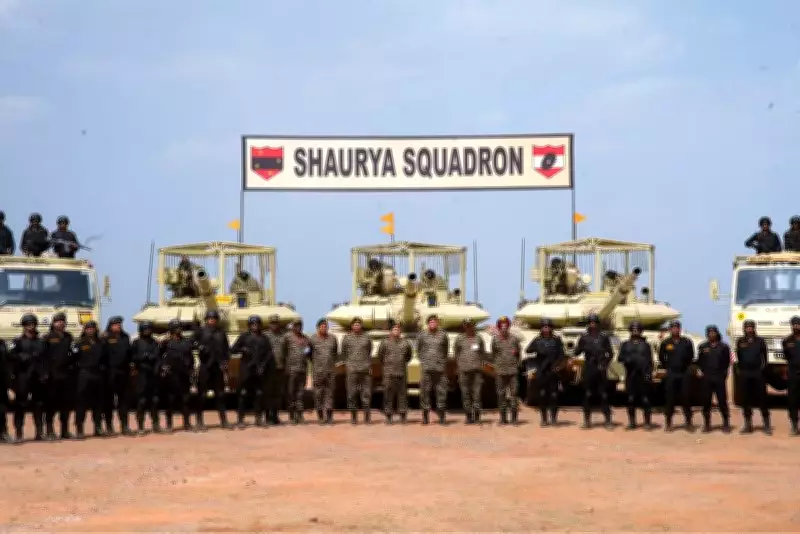
Indian Army Deploys Shaurya Squadrons: A New Era in Drone-Enabled Armoured Warfare
In a significant advancement for modern military operations, the Indian Army has officially launched the Shaurya Squadrons, specialized drone-equipped sub-units designed to be integrated directly into armoured regiments. This innovative concept aims to dramatically enhance surveillance, reconnaissance, and precision-strike capabilities at the tactical level, marking a pivotal shift in how ground forces engage in future conflicts.
Exercise Amogh Jwala: Proving Ground for Shaurya Squadrons
The capabilities of the Shaurya Squadrons were rigorously tested and demonstrated during Exercise Amogh Jwala, a major 13-day military drill conducted by the 31 Armoured Division. This exercise took place at the Babina Field Firing Ranges near Jhansi in March, focusing on validating multi-domain, high-intensity mechanized operations. The drill integrated a diverse array of assets, including armoured units, attack helicopters, fighter aircraft, and drones, to simulate realistic battlefield conditions.
During the exercise, the Shaurya Squadron operated as a modern combat element, seamlessly blending precision strikes with deep surveillance and close combat reconnaissance. Designed to seek further, strike deeper, and stay longer on the battlefield, the squadron showcased its ability to deliver real-time reconnaissance combined with swift and precise strike responses. This performance provided valuable operational insights, underscoring the squadron's potential to significantly boost the effectiveness of reconnaissance in contemporary warfare scenarios.

Compressing the Sensor-to-Shooter Loop
A key objective behind the induction of drones at the lowest field level is to compress the sensor-to-shooter loop from minutes to seconds, enabling faster targeting and engagement. By serving as the eyes and ears of armoured regiments, drones reduce the reliance on tanks, vehicles, and foot soldiers for reconnaissance missions. This shift minimizes the risk of ambushes and exposure to enemy forces, thereby improving overall survivability for troops.
The establishment of Shaurya Squadrons follows the Army's earlier initiative to raise Ashni Platoons, which are sub-units equipped with various types of surveillance and attack drones now integral to all infantry battalions. Both Shaurya and Ashni units consist of 25-30 troops specially trained in drone and counter-drone operations at the tactical level. These units employ a mix of surveillance drones, attack drones, and loitering munitions, granting frontline commanders real-time targeting information and precision-strike capability without needing to route requests through higher command chains. This autonomy provides commanders with greater operational independence, flexibility, and lethality.
Doctrinal Shift and Future Integration
Top military commanders emphasize that Unmanned Aerial Systems and drones are being integrated across all arms and services, representing a significant doctrinal shift in the Army's approach to future wars. Beyond precision strikes and surveillance, drones are expected to undertake a wide range of tasks, including electronic warfare, engineer functions such as obstacle breaching and mine laying, logistics and supply operations, and medical assistance.
The Indian Army currently operates approximately 65 armoured regiments, each equipped with 45 tanks, including Russian-origin T-72 and T-90 models, as well as the indigenous Arjun tank. Additionally, the mechanized forces include the Mechanised Infantry Regiment with 27 battalions and the Brigade of the Guards with 23 battalions, utilizing BMP-2/3 mechanized infantry combat vehicles.
Evolving Concepts and Technological Enhancements
Army officers note that the concept of Shaurya Squadrons is still evolving. An analysis of the first unit's performance in its maiden field exercise will identify areas for further refinement and innovation before institutionalization. The Army has already conducted several field drills involving Ashni Platoons, indicating a broader commitment to drone integration.

In a related development, the Army is exploring the conversion of ageing T-72 tanks into remotely controlled autonomous armoured fighting vehicles. This initiative aims to extend their employability beyond their expected retirement from 2030 onwards and enhance the Army's capability to conduct high-risk missions in a technology-intensive environment. Defence experts suggest that coupling such platforms with drones could dramatically boost armoured warfare capabilities while reducing risks to human life.
Furthermore, the Armoured Corps is actively equipping tanks with various counter-drone measures. The Ministry of Defence has issued requests for proposals to retrofit tanks with systems capable of detecting and neutralizing drones through soft or hard kill options, ensuring comprehensive protection against emerging threats.
The introduction of Shaurya Squadrons underscores the Indian Army's strategic focus on leveraging advanced technology to maintain a competitive edge in modern warfare, setting a new standard for armoured regiment operations in the digital age.





