Metroman E Sreedharan Unveils Revised Kerala High-Speed Rail Plan with Lower Cost and New Alignment
In a significant development for Kerala's transportation infrastructure, 'Metroman' E Sreedharan on Tuesday revealed a comprehensively revised blueprint for the proposed Kerala High Speed Rail (KSHR) project. The new plan features a fresh alignment and a substantially reduced estimated cost of Rs 54,000 crore, a sharp decline from his earlier projection of Rs 86,000 crore.
Project Details and Route Specifications
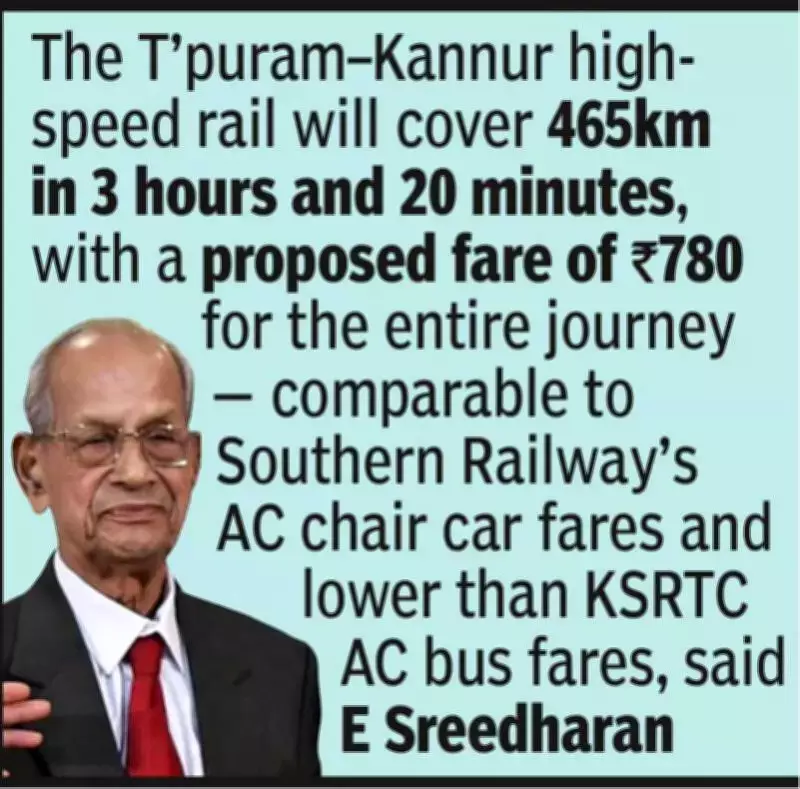
Addressing reporters at the DMRC office in Ponnani, Malappuram, Sreedharan outlined that the Thiruvananthapuram-Kannur high-speed rail corridor will span 465 kilometers, with a travel time of 3 hours and 20 minutes. The proposed fare for the full journey is set at Rs 780, which is comparable to AC chair car fares on Southern Railway and notably lower than KSRTC AC bus fares.
The revised alignment includes 20 stations, with two terminal stations. The route will commence at Thiruvananthapuram Central, passing through key locations such as Thiruvananthapuram airport, Varkala, Kollam, Kottarakara, Pathanamthitta, Thiruvalla, Kottayam, Vaikom, Ernakulam Bypass, Nedumbassery airport, Thrissur, Pattambi, Malappuram, Karipur airport, Kozhikode, Koyilandy, Vadakara, Thalassery, and terminating in Kannur.

Technical Specifications and Operational Features
The KHSR will operate on a standard gauge system, with no physical integration with the existing broad gauge network of Southern Railway. Approximately 445 kilometers of the corridor will be elevated, while 20 kilometers will run underground. Sreedharan emphasized the advantages of the standard gauge design, noting that axle loads will be only 16 tonnes compared to 25 tonnes for broad gauge. This design choice will result in lighter and sleeker elevated structures, achieving cost savings of over 20%.
The design speed for the rail line is set at 200 kmph, with a maximum operating speed of 180 kmph. The average commercial speed, accounting for acceleration, deceleration, and station stoppages, will be 140 kmph.
Each train will consist of eight coaches, providing a total seating capacity of 560 passengers, all configured as premium AC chair cars. Initially, trains will operate at intervals of 30 minutes during peak hours and one hour during non-peak hours. At 80% occupancy, the system is projected to carry 45,000 passengers daily. The capacity can be expanded to over 5 lakh passengers per day by increasing coaches to 12 and reducing service intervals to 5 minutes.
Green Initiative and Environmental Considerations
Sreedharan highlighted that the corridor will function as a green project, powered entirely by solar farms established along a 20-meter-wide land strip to be acquired. No land acquisition will be necessary for underground stretches. Post-construction, part of the acquired land can be leased back to original owners for cultivation or grazing, while approximately 50% will be retained for solar installations.
Funding Structure and Cost Analysis
The project will be executed by a special purpose vehicle (SPV), a joint venture between the Union and state governments, with equity participation in a 51:49 ratio. The estimated project cost of Rs 54,000 crore contrasts with the K-Rail estimate of Rs 63,941 crore. Assuming a construction period of 5 years and a 2% annual inflation rate, the completion cost is projected at Rs 56,500 crore.
Funding will follow the Konkan Railway Corporation model, with about 70% of the completion cost shared by the Centre and state in a 51:49 ratio. The remaining 30% will be raised through debt or bonds. Based on current estimates, the Centre's share will be approximately Rs 20,171 crore, and the state's share Rs 19,380 crore, translating to annual contributions of about Rs 4,034 crore and Rs 3,876 crore respectively over the 5-year period.
Future Expansion and Phase Two Plans
Sreedharan also mentioned potential extensions in a second phase, including routes from Kannur to Kasaragod, Kozhikode to Kalpetta, and Pattambi to Palakkad, among others. This phased approach aims to enhance connectivity across Kerala, leveraging the high-speed rail infrastructure for broader regional development.