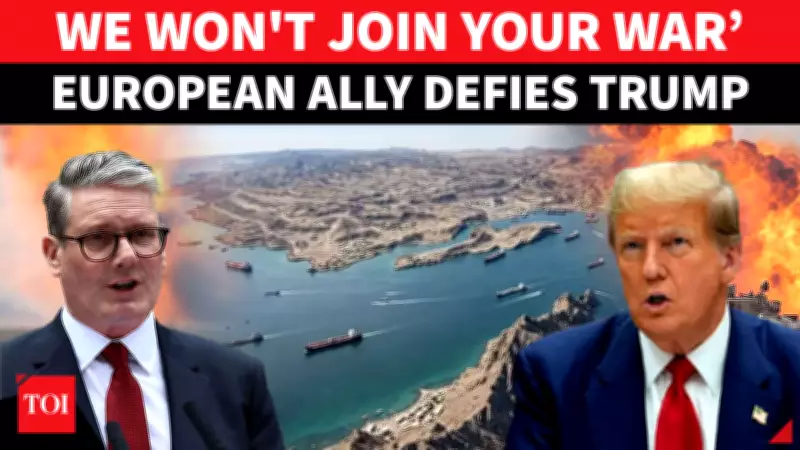
UK Prime Minister Firmly Declines US Call for Military Alliance in Persian Gulf
In a decisive move that underscores Britain's shifting foreign policy priorities, Prime Minister Keir Starmer has explicitly informed former US President Donald Trump that the United Kingdom will not participate in a proposed military coalition in the Strait of Hormuz. The refusal comes amid escalating tensions in the Iran conflict, which has already triggered significant economic repercussions globally.
Domestic Economic Support Takes Precedence Over Military Engagement
Speaking from Downing Street, Starmer emphasized that his government's immediate focus is on alleviating the financial strain on British households rather than deploying Royal Navy warships to the volatile region. "Our commitment is to the people of Britain first," Starmer stated, highlighting how the Iran war has directly doubled heating oil prices for approximately 1.5 million UK families.
Chancellor Rachel Reeves has confirmed that the Treasury has successfully allocated funds for direct cost-of-living support measures. This announcement follows a sharp surge in global oil prices, which peaked at $120 per barrel due to supply disruptions linked to the conflict.

Broader Economic and Diplomatic Implications
The UK's stance extends beyond military non-participation. In a notable divergence from US policy, Britain is maintaining its sanctions against Russia, rejecting American efforts to ease these restrictions as a means to stabilize global oil supplies. This decision reflects Starmer's delicate balancing act: safeguarding national economic interests while navigating complex international alliances.
Furthermore, the economic fallout has prompted UK mortgage lenders to reverse previously planned interest rate cuts, adding to the financial pressures on homeowners. Starmer's approach aims to insulate the British economy from the wider geopolitical turmoil, even as he attempts to sustain diplomatic cohesion within a coalition that remains largely theoretical at this stage.
Analysts note that Starmer's refusal to join Trump's Hormuz coalition signals a potential recalibration of UK-US relations under the new government, with domestic welfare taking clear precedence over military adventurism in foreign conflicts.