

Gurgaon Set for Major PNG Pipeline Expansion Following Government Directive
The city of Gurgaon is poised for a significant expansion of its piped natural gas infrastructure, with approximately 39 kilometers of new PNG pipelines planned across various sectors. This development comes in response to a directive from the Haryana government aimed at accelerating the establishment of comprehensive city gas distribution networks throughout urban areas.
Municipal Corporation Approves Extensive Pipeline Network
The Municipal Corporation of Gurgaon has formally approved proposals for laying around 38.8 kilometers of PNG pipelines under the City Gas Distribution framework. According to MCG officials, this expansion will be executed by two primary city gas distribution agencies: Haryana City Gas and Indraprastha Gas Limited.
MCG executive engineer Sandeep Sihag confirmed, "Permissions were granted in accordance with a directive issued by the Haryana government to speed up the city gas infrastructure network." The expansion is expected to substantially increase PNG connectivity across residential colonies, commercial markets, and emerging sectors throughout Gurgaon.

Detailed Pipeline Distribution Across Key Areas
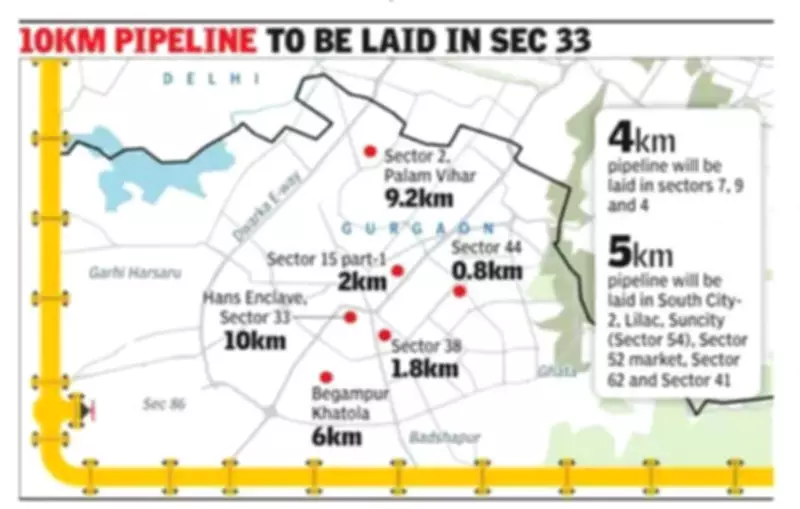
Letters of intent for the pipeline projects were issued between February 12 and April 1, covering numerous strategic locations. The planned distribution includes:
- 10 kilometers in Hans Enclave, Sector 33
- 5 kilometers across South City-2, Lilac, Suncity (Sector 54), Sector 52 market, Sector 62, and Sector 41
- 6 kilometers in Begampur Khatola
- 9.2 kilometers in Sector 2 (Palam Vihar)
- 4 kilometers across Sectors 7, 9, and 4
- 2 kilometers in Sector 15 Part-1
- 0.8 kilometers in Sector 44
- 1.77 kilometers in Sector 38
MCG officials have indicated that excavation and pipeline laying operations are expected to commence shortly in these designated areas.
Current Gas Connection Landscape and Future Targets
The expansion initiative addresses a significant disparity in gas connection types throughout Gurgaon. Current statistics reveal approximately 10.2 lakh domestic LPG connections compared to just 83,603 PNG connections, with Indraprastha Gas serving 21,692 customers and Haryana City Gas providing 61,911 connections.
Haryana City Gas CEO AK Jana outlined ambitious targets, stating, "We have set a target to provide 25,000 domestic PNG connections by the end of June and another 25,000 by September-end." The company has received approximately 75,000 applications for PNG connections, with around 65,000 already fulfilled and 10,000 requests currently pending.
Jana noted a significant shift in consumer behavior, explaining, "Earlier, we were reaching out to consumers, but now residents are approaching us for connections. Around 25 housing societies in Gurgaon are currently awaiting PNG connectivity." Following recent approvals from Gurgaon authorities, the company has already laid a 20-kilometer pipeline network within the past 15 days.
Government Directive Accelerates Approval Process
The pipeline expansion follows a recent order issued by Ashok Kumar Meena, commissioner and secretary of the urban local bodies department. Municipalities have been directed to expedite approvals for CGD pipelines to strengthen domestic gas supply infrastructure.
The directive specifies that pending CGD pipeline applications should be treated as deemed approved, while new applications must be cleared within 24 hours. Additionally, municipal bodies have been instructed not to impose restrictions on working hours or seasons for CGD projects, provided appropriate safety precautions are maintained.
Resident Perspectives and Community Impact
Suncity RWA chairperson Kusum Sharma expressed optimism about the accelerated timeline, stating, "We have been pursuing PNG connections for the past two years, but with the government now pushing the project more actively, work is expected to begin on the ground soon. For the expansion of the PNG network, cooperation from residents is essential."

The expanded PNG network is expected to substantially reduce dependence on traditional LPG cylinders while improving accessibility to cleaner, more convenient piped natural gas. This infrastructure development aligns with broader initiatives to enhance urban utility services and promote sustainable energy solutions throughout the National Capital Region.





