

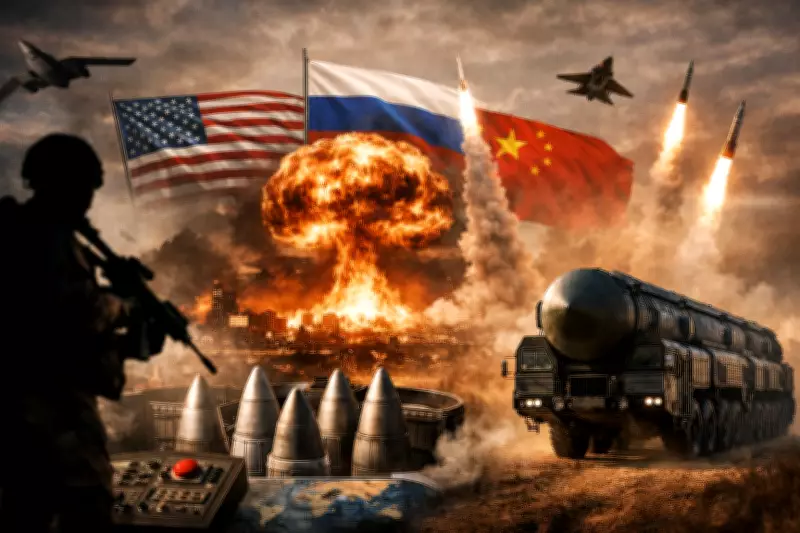
World Faces Unprecedented Nuclear Uncertainty as Key Treaty Expires
In a world fractured by kinetic conflicts, terrorism, geopolitical upheaval, and weaponized economics, the global community finds itself at war with itself more intensely than at any time since the end of World War II in 1945. These conflicts increasingly involve nuclear and near-nuclear powers, creating profound international concern. Global institutions like the United Nations and its Security Council appear largely incapable of influencing powerful nuclear states to exercise restraint should situations deteriorate further.
The Nuclear Deterrence Paradox and Historical Context
The possession of nuclear weapons has traditionally been viewed not only as enhancing offensive capabilities but also as providing credible deterrence. Unfortunately, wars continue to be fought beneath the nuclear threshold, with the constant risk that a defeated power might resort to extreme measures, potentially triggering nuclear devastation. The specter of nuclear war persisted from the 1950s through the early 1990s, synonymous with the Cold War era. This threat was widely understood through the concept of Mutually Assured Destruction (MAD), recognizing that any nuclear conflict would likely result in catastrophic destruction for all combatants.
During the Cold War, better sense prevailed between the two nuclear superpowers, the United States and Russia (formerly the Soviet Union). Their cooperation culminated in the 2010 Strategic Arms Reduction Treaty (START), which successfully expired last week. Despite its limitations, START significantly curbed the nuclear arms race by restricting the number of deployable warheads for both nations.

Current Negotiations and China's Defiant Stance
As the United States and Russia commenced negotiations for a new treaty in Abu Dhabi over the past week, China—whose nuclear arsenal is expanding rapidly—has rejected calls to participate in these crucial discussions. The Chinese government, while expressing regret over START's expiration, has formally declared that it "will not participate in nuclear disarmament negotiations at this stage." China further justified its position by stating that its "nuclear capabilities are of a totally different scale as those of the United States and Russia."
According to military analysts, China's nuclear arsenal is growing at an alarming rate of approximately 100 warheads annually, with current estimates placing their stockpile at around 600 warheads. The Stockholm International Peace Research Institute (SIPRI), a global authority on military matters, reports that Pakistan possesses nearly 170 nuclear warheads compared to India's 180, while Russia and America collectively control more than 80 percent of the world's total nuclear warheads. The expired START treaty had limited both superpowers to a maximum of 1,550 warheads each.
India's Nuclear History and Doctrine
India faces the unique challenge of being situated between two adversarial nuclear neighbors. While steadily building its nuclear capabilities over past decades, India maintains constant nuclear readiness. The nation's nuclear journey began remarkably early when Prime Minister Jawaharlal Nehru met young scientist Homi Bhabha in 1945, initiating India's atomic energy program for peaceful purposes shortly before independence. This established India's Atomic Energy Department under Nehru's scientifically-minded leadership.
India demonstrated global leadership in nuclear matters by becoming the first country to call for a global ban on nuclear testing in 1954. In 1974, Prime Minister Indira Gandhi oversaw India's first nuclear test, which resulted in significant Western sanctions, particularly from the United States. A landmark moment occurred in 1988 when Prime Minister Rajiv Gandhi presented a comprehensive three-stage Action Plan to the United Nations for total nuclear disarmament, earning worldwide acclaim.

India conducted comprehensive nuclear testing in 1998 during Prime Minister Atal Bihari Vajpayee's government. Despite not signing the Nuclear Non-Proliferation Treaty (NPT), India has consistently adhered to strict export controls and nuclear safeguards for itself and other nations. India maintains a clear No-First-Use (NFU) policy, declaring a doctrine of credible minimum deterrence that pledges not to employ nuclear weapons first, particularly against other nuclear weapon states. However, India reserves the right to respond with nuclear weapons against biological or chemical attacks.
India's Treaty Commitments and Current Global Concerns
India has signed and ratified the Partial Test Ban Treaty, which prohibits atmospheric, outer space, and underwater nuclear weapons testing. Regarding the Comprehensive Nuclear Test Ban Treaty, India has committed to support it only if nuclear weapon states agree to time-bound disarmament. Since May 1998, India has observed a voluntary moratorium on nuclear testing.
With START's expiration, United Nations Secretary-General Antonio Guterres has issued a stark warning: "For the first time in more than half a century, we face a world without any binding limits on the strategic arsenals" of Russia and the United States. He further expressed that "this dissolution of decades of achievement could not come at a worse time—the risk of a nuclear weapon being used is the highest in decades."
Security Implications and Future Directions
As China refuses to join renewed disarmament efforts and Pakistan maintains its nuclear posture, India must carefully factor these nuclear uncertainties into its security calculations. This necessitates potential revisions to India's nuclear doctrine and preparedness, even as the international community widely recognizes India as a responsible nuclear power.
Simultaneously, India must continue championing global nuclear disarmament initiatives, recognizing that this remains the only viable path to prevent a potential Nuclear Armageddon. The current global landscape presents both unprecedented challenges and opportunities for nuclear diplomacy, with India positioned to play a crucial role in shaping the future of international nuclear security.





