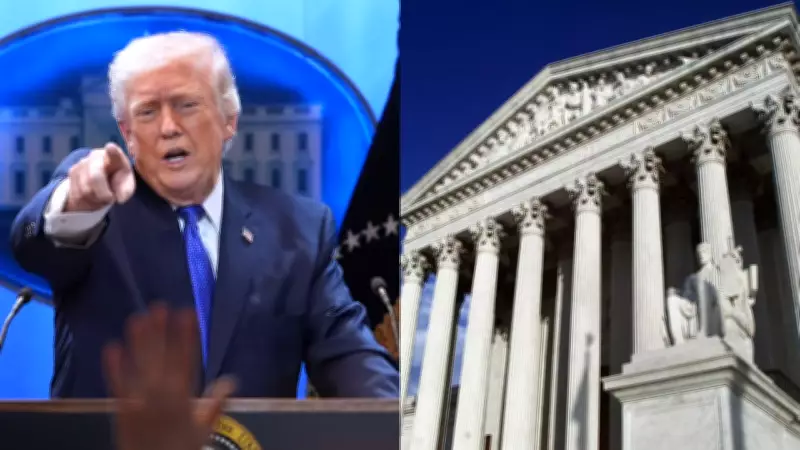
US Supreme Court Delivers Major Blow to Trump Tariff Authority
The US Supreme Court issued a landmark ruling on Friday, striking down numerous tariffs imposed by former President Donald Trump. In a 6-3 decision, the court determined that the International Emergency Economic Powers Act (IEEPA), a 1977 statute Trump relied on, does not grant presidents the authority to impose such duties. This ruling represents a significant defeat for Trump and marks a relatively rare instance of judicial pushback against his aggressive use of tariffs as leverage in economic and foreign policy during his second term.
Majority Coalition and Dissenting Voices
The majority opinion was supported by Chief Justice John Roberts and Justices Sonia Sotomayor, Elena Kagan, Neil Gorsuch, Amy Coney Barrett, and Ketanji Brown Jackson. Justices Clarence Thomas, Samuel Alito, and Brett Kavanaugh dissented from the decision. The case centered on Trump's invocation of IEEPA to justify sweeping tariffs on nearly every country, citing "large and persistent" trade deficits and failures by nations like China, Canada, and Mexico to curb the flow of illicit fentanyl and other drugs into the United States.
Key Reasons Behind the Court's Decision
The court outlined several critical factors in its ruling:

- Statutory Language: IEEPA authorizes the president to "regulate ... importation" to address threats, but the statute does not explicitly mention tariffs, duties, levies, or taxes, which the court deemed significant.
- Historical Precedent: Before Trump, no president had interpreted IEEPA to allow tariffs, indicating Congress never intended to grant such power.
- Nature of Tariffs: Tariffs differ from other emergency tools like quotas or embargoes because they directly raise revenue for the Treasury, placing them outside the statute's intended scope.
- Major Questions Doctrine: Conservative justices in the majority applied the principle that major economic powers claimed by the executive must be clearly authorized by Congress.
- Unanimous Core Conclusion: All six majority justices agreed that IEEPA is silent on tariff authority and historically was not understood to include it.
Chief Justice Roberts emphasized in his opinion: "Our task today is to decide only whether the power to 'regulate ... importation,' as granted to the president in IEEPA, embraces the power to impose tariffs. It does not."
Economic and Political Implications
The ruling has far-reaching consequences. It opens the door to potential refunds of over $100 billion in tariff revenue to importers, with lower courts, the US Court of International Trade, Customs and Border Protection, and the Treasury Department expected to oversee the process. While importers may be directly eligible for refunds, compensation for businesses and consumers affected by higher prices remains unclear. The tariffs had increased costs for goods such as furniture, apparel, and electronics, and economists warn that prices may not drop quickly due to ongoing uncertainty and Trump's pursuit of replacement tariffs.
Trump's Response and Future Actions
Reacting angrily to the decision, Trump swiftly announced plans to impose new tariffs under different laws. He invoked Section 122 of the 1974 Trade Act, a provision previously unused by any president, to implement a 10% tariff on all imports starting February 24. Additionally, he indicated intentions to pursue further tariffs through Section 301 investigations into other countries' trade practices, signaling that the battle over presidential tariff powers is far from over.
Legal and Practical Fallout
The decision creates a complex legal landscape. Importers may seek reimbursement through established channels, while other businesses could file lawsuits for compensation. The ruling underscores the limits of executive authority in trade policy and highlights the ongoing tensions between presidential actions and congressional intent in emergency powers legislation.