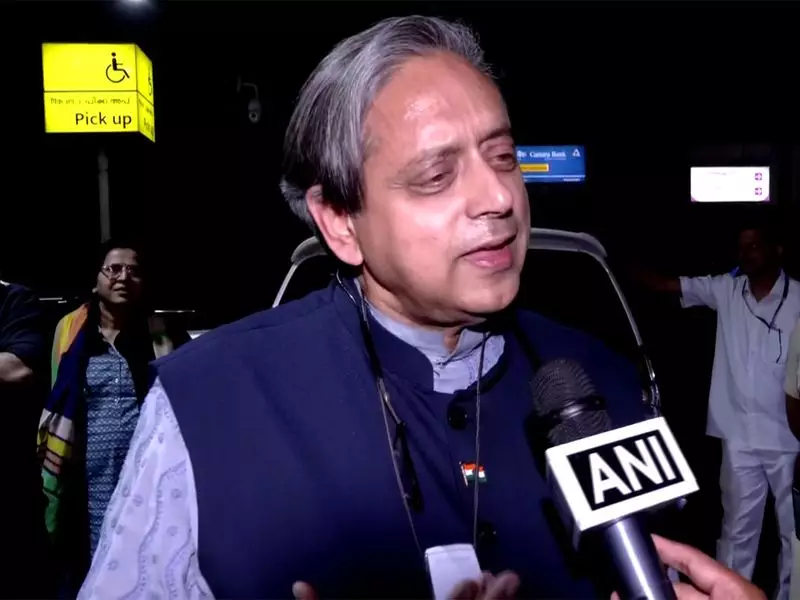
Senior Indian parliamentarians from the Congress party have launched a scathing critique of the United States' recent decision to reimpose crushing sanctions on Venezuela's crucial oil sector. Shashi Tharoor and Abhishek Manu Singhvi have labeled the American action as emblematic of a "law of the jungle" approach in global affairs, arguing it blatantly disregards established principles of international law.
A Condemnation of Coercive Measures
The controversy stems from the Biden administration's announcement on April 17, 2024, to not renew a key license that had temporarily eased sanctions on Venezuela's state-owned oil company, PDVSA. This license, known as General License 44, was issued in October 2023 following a political agreement between the Venezuelan government and the opposition. Its non-renewal now forces foreign companies to wind down their operations with PDVSA by May 31, dealing a severe blow to the country's primary economic engine.
In a detailed post on social media platform X, former Union Minister Shashi Tharoor expressed his strong disapproval. He stated that the US move, justified by Washington as a response to Venezuela's failure to meet certain electoral commitments, is a punitive measure that hurts the Venezuelan people more than its government. Tharoor emphasized that such unilateral sanctions violate the fundamental tenets of the United Nations Charter and the principles of sovereign equality among nations.

Singhvi's Legal and Historical Critique
Echoing and expanding on this sentiment, Congress spokesperson and eminent lawyer Abhishek Manu Singhvi provided a pointed legal analysis. He connected the US action on sanctions to the broader territorial dispute between Venezuela and Guyana over the Essequibo region. Singhvi accused the United States of employing a double standard: while it supports Guyana's sovereignty based on a 1899 arbitral award, it simultaneously dismisses Venezuela's sovereign rights over its own natural resources through sanctions.
"The US insists Guyana’s borders, settled in 1899, are sacred, but Venezuela’s sovereignty over its oil, recognized for over a century, is violable at Washington’s whim," Singhvi argued. He characterized this as a "classic case of might is right" and a selective application of international law that serves geopolitical interests rather than justice. Both leaders underscored that the reimposition of sanctions would exacerbate the humanitarian crisis in Venezuela, leading to increased migration and regional instability.
Broader Implications for Global Order
The forceful comments from Tharoor and Singhvi highlight a growing concern among many nations regarding the use of unilateral economic measures as a tool of foreign policy. Their critique frames the US decision not just as an issue concerning Venezuela, but as a test case for a rules-based international order. They warn that allowing powerful states to routinely bypass multilateral frameworks sets a dangerous precedent, undermining global institutions and legitimizing coercion over cooperation.
The lawmakers' statements also reflect a perspective often heard in the Global South, which views such sanctions as instruments of political pressure that disproportionately affect civilian populations. As the May 31 deadline for wind-down operations approaches, the controversy is likely to fuel further debate on the ethics and legality of extraterritorial sanctions and the need for diplomatic engagement over punitive actions in resolving international disputes.