

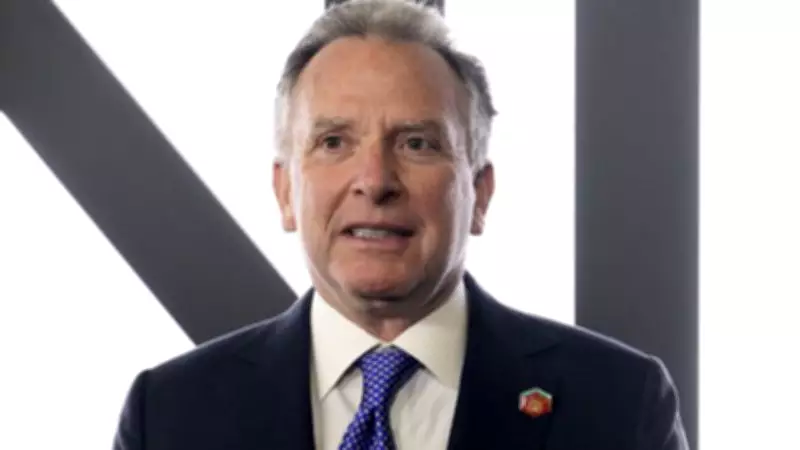
Trump's Special Envoy Proposes Direct Zelenskyy-Putin Meeting for Territorial Resolution
In a significant development from Kyiv, Steve Witkoff, the special envoy appointed by former President Donald Trump, addressed the Yalta European Strategy gathering with a bold proposal. Witkoff suggested that resolving the contentious territorial issues in the ongoing Russia-Ukraine war could be delegated to a direct meeting between Ukrainian President Volodymyr Zelenskyy and Russian President Vladimir Putin.
Washington's Role and Negotiation Tracks
Joining the event online from Washington, D.C., Witkoff emphasized that the United States is not imposing any solutions on Ukraine. This statement comes amid widespread reports that the U.S. has been pressuring Zelenskyy to accept Russian demands, including relinquishing control over parts of the Donbas region still held by Ukraine. This area comprises a critical fortress belt of cities, viewed as Ukraine's last defensive line in the eastern front.
"Territorial issues have been left to one side, and we are focused on providing strong security protocols for Ukraine and a prosperity agreement," Witkoff declared. He outlined that the current round of negotiations among the U.S., Ukraine, and Russia operates on three separate tracks: security, economic recovery, and political matters.

Progress on Security Guarantees
Highlighting advancements in the talks, Witkoff asserted that security protocols for Ukraine have been practically solved. "We understand that Ukrainians need to feel this won't happen again. We are looking at NATO's Article 5-like security for Ukraine where Europe is offering a basket of security guarantees and the U.S. will provide back-up," he explained.
However, credible security guarantees remain a major sticking point. A European coalition has expressed readiness to deploy troops to Ukraine, but only after a ceasefire is established. Russia has consistently refused to accept any European military presence on Ukrainian soil, complicating the negotiation process.
Concerns and Kremlin's Response
This stance has raised concerns that Trump might be being manipulated by Moscow in the negotiations. Witkoff countered these fears, stating, "President Trump is not naive. We keep trying to get the right peaceful solution. We have good communication with all sides, including the Europeans."
Simultaneously, Kremlin spokesperson Dmitry Peskov responded to the proposal, indicating that a summit involving the leaders of the U.S., Ukraine, and Russia should only occur at the final stages of peace talks. This statement dampens hopes for a quick resolution, suggesting that significant hurdles remain before any high-level meeting can materialize.
The ongoing diplomatic efforts underscore the complex dynamics at play, with territorial disputes, security assurances, and international involvement all critical factors in seeking a lasting peace in the region.






