

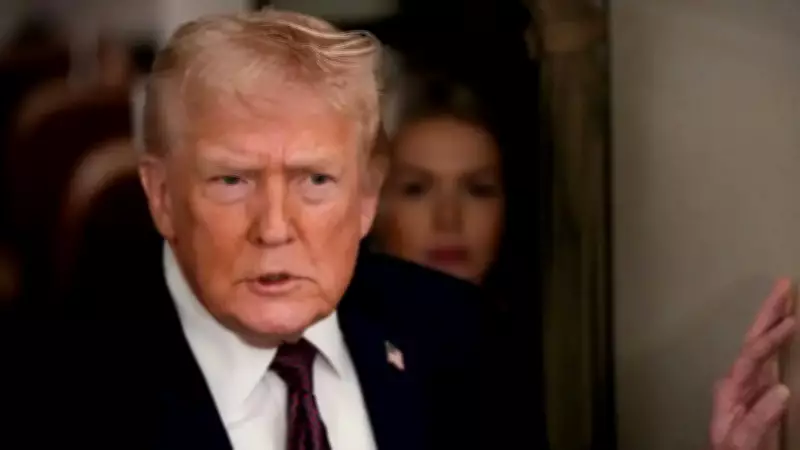
Trump Announces US Navy Blockade of Strait of Hormuz Following Failed Iran Talks
In a dramatic escalation of tensions, US President Donald Trump has declared that the United States Navy will immediately begin blockading the Strait of Hormuz, a critical global oil chokepoint. This announcement comes after peace negotiations between Iran and the US reached a dead end, with the core dispute centered on Iran's nuclear program.
Deadlock in Diplomacy and Accusations of Extortion
Trump made the declaration in a post on Truth Social, where he accused Tehran of creating uncertainty in the strait by citing possible naval mines, which he labeled as "world extortion." He stated, "So, there you have it, the meeting went well, most points were agreed to, but the only point that really mattered, nuclear, was not. Effective immediately, the United States Navy, the finest in the world, will begin the process of blockading any and all ships trying to enter or leave the Strait of Hormuz."
He further explained that the blockade aims to prevent Iran from profiting from what he called an illegal act, adding, "At some point, we will reach an 'all being allowed to go in, all being allowed to go out' basis, but Iran has not allowed that to happen by merely saying, 'there may be a mine out there somewhere,' that nobody knows about but them."

Military Threats and Expanded Enforcement
Trump issued stark warnings, saying that if Iranian forces fire at US or civilian vessels, "they will be blown to hell." He also instructed the Navy to interdict vessels in international waters that have paid tolls to Iran, asserting, "No one who pays an illegal toll will have safe passage on the high seas. We will also begin destroying the mines the Iranians laid in the straits."
In his post, Trump claimed that Iran's military capabilities have been devastated, stating, "Their navy is gone, their air force is gone, their anti-aircraft and radar are useless. Khomeini, and most of their 'leaders,' are dead, all because of their nuclear ambition." He added that other countries would be involved in the blockade and hinted at further military action, saying, "Additionally and, at an appropriate moment, we are fully 'locked and loaded,' and our military will finish up the little that is left of Iran."
Background of Collapsed Negotiations
This development follows the collapse of negotiations between the US and Iran in Islamabad, Pakistan, without an agreement. According to US Vice President JD Vance, the primary sticking point was Iran's nuclear program, which he described as a "red line" for the Trump administration. Iran was reportedly told to end its program and halt uranium enrichment.
Meanwhile, Iran has responded by calling the US demands "unreasonable" and blaming Washington for the failure of the talks. Iran has consistently denied seeking nuclear weapons but insists on its right to a civilian nuclear program. Experts note that Iran's stockpile of enriched uranium, while not weapons-grade, is only a short technical step away from becoming so.
Regional Impact and Escalating Conflict
The situation has already had severe consequences in the region. Since the US and Israel launched a war on February 28, it has resulted in significant casualties, including at least 3,000 deaths in Iran, 2,020 in Lebanon, 23 in Israel, and more than a dozen in Gulf Arab states. The conflict has also caused lasting damage to infrastructure across several Middle Eastern countries.
Iran's control over the Strait of Hormuz has largely severed the Persian Gulf and its vital oil and gas exports from the global economy, leading to soaring energy prices worldwide. The new US blockade threatens to further exacerbate these economic and humanitarian crises, raising fears of a broader regional conflict.






