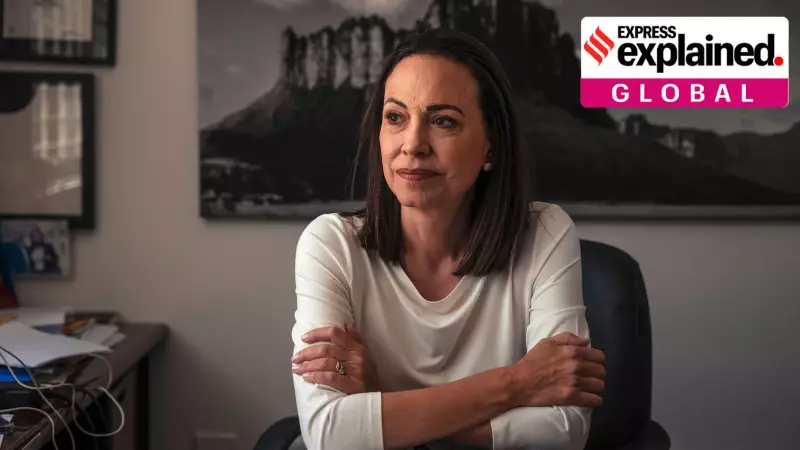
In a striking political reversal, US President Donald Trump has publicly dismissed Venezuelan opposition leader Maria Corina Machado, a fellow conservative and 2025 Nobel Peace Prize laureate, as a viable leader for her country. This cold shoulder comes despite Machado's long-standing alignment with Trump's hardline policies against the Nicolas Maduro regime and her recent dedication of the Nobel honour to the American president.
The Sudden Chill: From Ally to 'No Respect'
The rift became public on Saturday, January 4, 2026, following a US military operation targeting Venezuelan vessels. When asked about collaborating with Machado, Trump offered a blunt assessment. "I think it would be very tough for her to be the leader," he stated. "She doesn't have the support within, or the respect within, the country. She's a very nice woman, but she doesn't have the respect."
This statement starkly contrasts with Machado's actions just a day later. On Monday, January 6, during an appearance on Fox News, she reaffirmed her plan to return to Venezuela "as soon as possible" and reiterated her intention to share her Nobel Prize with Trump.
Who is Maria Corina Machado?
Maria Corina Machado, 58, has been a principal adversary of the Maduro government for over two decades. The daughter of a wealthy industrialist, she is a free-market conservative whose platform includes the controversial call for privatising Venezuela's vast oil industry.
Her political journey includes a landslide victory in the 2023 opposition primary, where she secured 93% of the vote. However, the Maduro regime barred her from holding public office, preventing her from contesting the 2024 presidential election. She subsequently endorsed a surrogate candidate, retired diplomat Edmundo Gonzalez.
Following disputed election results and threats to her life, Machado went into hiding. In a daring move, she defied a travel ban in December 2025 to attend the Nobel ceremony in Oslo, travelling in disguise through military checkpoints.
She was awarded the Nobel Peace Prize in 2025 "for her struggle to achieve a just and peaceful transition from dictatorship to democracy."
Three Key Reasons Behind Trump's Snub
Analysts point to a confluence of factors that led to the current diplomatic freeze between Trump and his erstwhile ally.
First, a fractured personal relationship. Reports from The New York Times and The Washington Post indicate Machado became a "source of friction" in Trump's administration. She reportedly snubbed an in-person meeting with a Trump envoy, opting for a phone call instead. More critically, Trump was allegedly deeply displeased when Machado accepted the Nobel Peace Prize. White House sources told The Post that her acceptance was considered the "ultimate sin," causing Trump to lose interest in supporting her. Trump had reportedly expected to win the prize himself for his role in Middle East ceasefire efforts.
Second, diverging strategic interests. The Trump administration's primary focus in Venezuela appears to be securing control over its oil sector, rather than championing a democratic transition. Secretary of State Marco Rubio indicated that ensuring total regime change would be a costly, long-term military commitment. Instead, the US is now seen as favouring cooperation with Maduro's former Vice President and current interim leader, Delcy Rodriguez, viewing it as a more pragmatic path to secure energy interests.
Third, a desire to avoid past failures. Trump's previous bet on opposition figure Juan Guaidó in 2019 ended with Guaidó in exile and Maduro still in power. The administration now questions Machado's ability to lead, noting that much of the opposition is exiled and that her support for harsh US sanctions has alienated Venezuelan business leaders who work with Maduro. Her refusal to engage with the existing government, while a core part of her strategy, has also limited her coalition-building prospects inside the country.
The situation leaves the future of US-Venezuela relations in a complex stalemate. While the Maduro regime has been ousted in what was described as a "quintessentially American" move, Washington's preferred successor is not the celebrated Nobel laureate, but a figure from within the old guard who can guarantee stability and access to oil—a calculation that places realpolitik firmly above democratic ideals.