

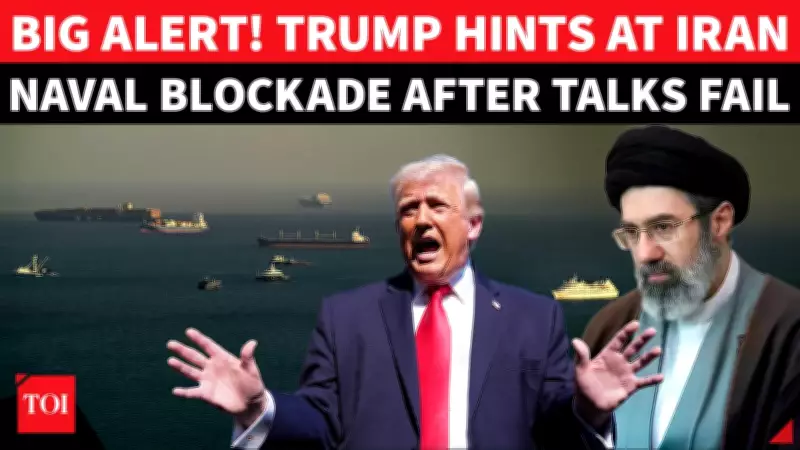
Trump's Stark Warning: Naval Blockade Looms Over Iran After Failed Negotiations
In a dramatic escalation of tensions, former U.S. President Donald Trump has hinted at the possibility of imposing a full naval blockade on Iran. This development comes after 21 hours of ceasefire negotiations in Islamabad concluded without any significant progress, leaving diplomatic efforts in a precarious state.
Amplified Threats on Social Media
Trump took to his Truth Social account to share a news article that suggested he holds a "Trump card" in the ongoing dispute with Tehran. The article speculated that this card could involve a naval blockade, drawing parallels to past U.S. actions in Venezuela. By amplifying this report, Trump has signaled a hardline stance, emphasizing that Iran's refusal to reopen the Strait of Hormuz could trigger severe consequences.
The Strait of Hormuz is a critical maritime chokepoint through which a substantial portion of the world's oil shipments pass. Any disruption here could have far-reaching implications for global energy markets and geopolitical stability.

Context of the Islamabad Talks
The recent negotiations in Islamabad were aimed at de-escalating tensions between the U.S. and Iran, but they ended in a stalemate. Key issues included:
- Strait of Hormuz Access: Iran's reluctance to guarantee unimpeded passage through the strait.
- Ceasefire Terms: Disagreements over the conditions for a lasting truce in the region.
- Regional Alliances: Concerns over Iran's military posturing and support from allies like China.
This failure has heightened fears of a renewed conflict, with both sides preparing for potential military confrontations.
Broader Regional Implications
Trump's threats are not occurring in isolation. Recent reports indicate that Iran has warned of a forceful response, and the U.S. has deployed two destroyers to the Strait of Hormuz. Additionally, there have been incidents such as drone strikes near Baghdad Airport targeting areas close to U.S. diplomatic convoys, further complicating the situation.
Other regional players are also involved. Israeli Prime Minister Netanyahu has threatened to bomb Iran's nuclear sites, adding another layer of complexity to the crisis. Meanwhile, China has been accused of boosting Iran's air defense capabilities, raising concerns about external support for Tehran.
Historical Precedents and Future Scenarios
The mention of a naval blockade evokes memories of past U.S. actions, such as those in Venezuela, where economic and military pressure was used to achieve political objectives. If implemented, a blockade against Iran could involve:
- Economic Sanctions: Restricting Iran's ability to export oil and other goods.
- Military Patrols: Increased U.S. naval presence in the Persian Gulf.
- Diplomatic Isolation: Efforts to rally international support against Iran.
However, such a move risks provoking a direct military confrontation, given Iran's capabilities and its alliances with groups like Hezbollah, which has already engaged in deadly clashes with Israeli forces.
Conclusion: A Tense Standoff
As the world watches, the standoff between the U.S. and Iran remains fraught with uncertainty. Trump's social media post has underscored the volatility of the situation, with the threat of a naval blockade adding to the already high stakes. The failure of the Islamabad talks suggests that diplomatic solutions are increasingly elusive, potentially paving the way for more aggressive actions in the near future.
The international community is closely monitoring these developments, aware that any escalation could have devastating consequences for regional and global security.






