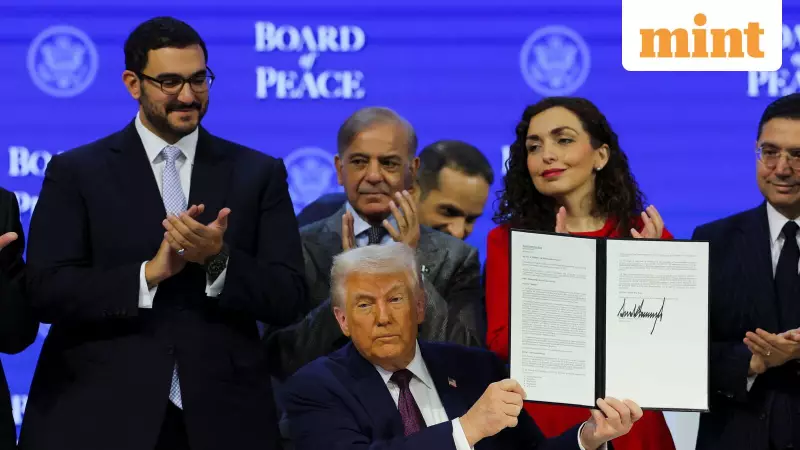
Trump Launches Gaza 'Board of Peace' Initiative at Davos Summit
In a significant diplomatic move, US President Donald Trump unveiled his much-anticipated Gaza 'Board of Peace' during the Davos World Economic Forum on Thursday. The initiative has garnered support from 35 nations, including key players such as the United Arab Emirates and Pakistan, marking a concerted effort to address the post-conflict future of the war-torn territory.
Commitment to Demilitarization and Reconstruction
President Trump emphasized the board's dual mandate in his opening remarks, stating a firm commitment to ensure Gaza is demilitarized and "beautifully rebuilt." He expressed confidence in the project's appeal, noting that "everybody" wants to participate and highlighting ongoing collaboration with international bodies, including the United Nations. A senior administration official, as reported by AFP, confirmed that of the 60 nations invited, 35 have agreed to sign on, underscoring the initiative's growing momentum.
Mandate and Objectives of the Peace Board
The Peace Board is poised to play a pivotal role in Gaza's transition following the ceasefire that took effect on October 10, 2025, which is now entering its second phase. Its comprehensive mandate includes:

- Formation of a new Palestinian committee in Gaza to oversee local governance.
- Deployment of an international security force to maintain stability.
- Disarmament of Hamas and other militant groups.
- Reconstruction of infrastructure and communities devastated by the conflict.
This structured approach aims to foster long-term peace and development in the region.
List of Participating and Non-Participating Nations
According to AP reports, the following countries have accepted invitations to join the Board of Peace:
- Argentina
- Armenia
- Azerbaijan
- Bahrain
- Belarus
- Egypt
- Hungary
- Indonesia
- Jordan
- Kazakhstan
- Kosovo
- Morocco
- Pakistan
- Qatar
- Saudi Arabia
- Turkey
- United Arab Emirates
- Uzbekistan
- Vietnam
Conversely, several nations have declined participation at this stage, including France, Norway, Slovenia, Sweden, and the United Kingdom. Additionally, a group of invited countries remains noncommittal, such as Cambodia, China, Croatia, Germany, India, Italy, the European Union's executive arm, Paraguay, Russia, Singapore, Thailand, and Ukraine, indicating ongoing diplomatic deliberations.
Key Attendees at the Peace Board Launch
The launch event at Davos featured high-profile attendees, underscoring the initiative's global significance. Notable US representatives included Secretary of State Marco Rubio, US special envoy Steve Witkoff, and Jared Kushner, the president's son-in-law and a key overseas negotiator. International presence was robust, with top diplomats and leaders such as Saudi Arabia's Foreign Minister Prince Faisal bin Farhan, Azerbaijan's President Ilham Aliyev, Armenian Prime Minister Nikol Pashinyan, Paraguayan President Santiago Peña, and President Kassym-Jomart Tokayev of Kazakhstan expected to participate.
Further adding to the event's prestige, Argentine President Javier Milei and Indonesian President Prabowo Subianto, both allies of Trump, were in attendance, along with heads of several state-run sovereign wealth funds, as reported by AFP. This diverse assembly highlights the broad-based support and collaborative spirit driving the Peace Board forward.