

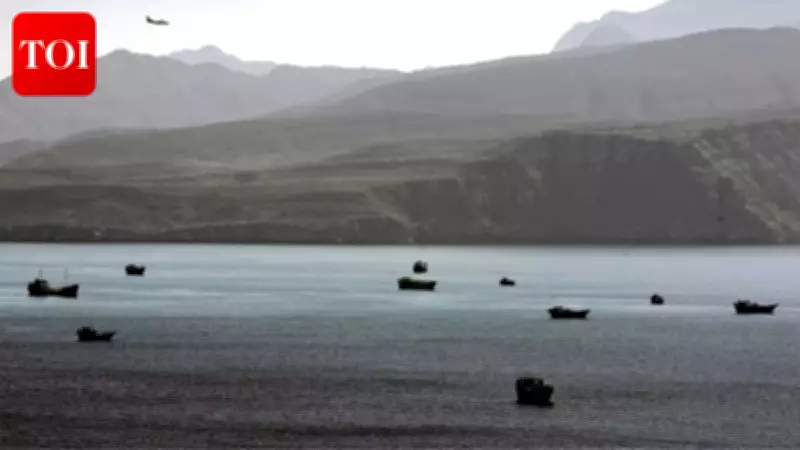
Trump Urges Global Coalition to Deploy Warships to Strait of Hormuz
Former US President Donald Trump has called upon nations worldwide to dispatch warships to seize control of the strategically vital Strait of Hormuz, declaring it a collective international duty to break Iran's blockade as global oil prices soar. Speaking on March 13, Trump appealed for contributions from allies including the United Kingdom, France, Japan, and even China to bolster what he termed his "beautiful armada," though responses from these nations have remained notably tepid.
The Geographic Challenge of the Strait
The Strait of Hormuz represents one of the world's most critical maritime chokepoints, funneling an estimated 20-30% of global oil trade through its narrow passage. The strait features Iranian-dominated northern shores and Omani southern flanks, with its tightest point measuring just 34 kilometers wide. Shipping lanes are constrained to just 4 kilometers wide in each direction, creating an environment where establishing a defensible line against persistent threats proves virtually impossible.
Even the formidable US Navy, with its Nimitz-class aircraft carriers and advanced F-35 squadrons, struggles in these confined waters where ship maneuvers require turning radii extending several kilometers. Iran's elevated coastal terrain provides strategic advantages for over-the-horizon strikes using truck-mounted Khalij Fars ballistic missiles with a 300-kilometer range, which can outpace both US naval artillery and some carrier aircraft launch sequences.

Iran's Formidable Anti-Access Capabilities
Iran has developed a sophisticated layered anti-access/area-denial (A2/AD) network specifically tailored for the Hormuz environment. This includes:
- Over 3,000 anti-ship cruise missiles including Noor and Qader variants
- Ballistic missile systems like the Hormuz-1 capable of targeting both tankers and high-value carriers
- Mobile launchers concealed within coastal caves along Iran's 1,600-mile coastline
- Swarm tactics using Shahed-136 drones designed to overwhelm advanced radar defenses
- More than 20,000 fast inshore attack craft executing "hornet's nest" tactics
- Six Kilo-class submarines and numerous mini-subs operating in the Gulf's shallow, murky waters
Recent events demonstrate Iran's persistent capability to disrupt shipping despite US military actions. Following strikes on Kharg Island, no tankers transited freely on March 14, with Islamic Revolutionary Guard Corps speedboats continuing to harass approaches to the strait.
The Logistical Nightmare of Strait Protection
Securing the Strait of Hormuz presents monumental logistical challenges:
- Escorting more than 60 daily oil tankers requires round-the-clock patrols that would tax the US Navy's 290 vessels already stretched across global theaters
- Resupply operations depend on vulnerable bases like Bahrain's Fifth Fleet headquarters, which falls within Iranian missile range
- Daily tanker escorts could consume approximately 10,000 tons of fuel weekly
- Regional allies including Saudi Arabia and the United Arab Emirates hesitate to expose critical infrastructure to potential Iranian reprisals
European Union foreign policy chief Kaja Kallas emphasized diplomatic priorities, stating, "Nobody is ready to put their people in harm's way. We have to find diplomatic ways to keep this open so that we don't have a food crisis, fertilizers crisis, energy crisis as well."
Why Trump's Proposed Armada Faces Limitations
Trump's envisioned naval force, while formidable, encounters significant limitations in the Hormuz environment. The proposed "beautiful armada" would include:
- The USS Abraham Lincoln aircraft carrier with 60+ F-35C and F/A-18 Super Hornets
- Two destroyers and two cruisers equipped with Aegis defense systems
- Two Virginia-class attack submarines for undersea screening
- Littoral combat ships for mine countermeasures
- USNS Pathfinder survey vessels
Despite this concentration of military power featuring 90+ aircraft, 500+ missiles, and Tomahawk cruise missile capabilities, several critical vulnerabilities remain:

Aircraft carriers require 4-6 kilometer turning radii, exposing flight decks to shore-launched ballistic missiles from coastal hideouts. F-35 aircraft, while stealthy, depend on carrier catapults vulnerable during high-threat transits. Virginia-class submarines excel in deep waters but struggle in Hormuz's shallow 100-foot depths where Iran's quieter, Gulf-adapted submarines operate effectively.
Furthermore, US destroyers could rapidly deplete their ammunition reserves against Iran's estimated 3,000+ anti-ship missiles and drone swarms, while mine-hunting vessels remain vulnerable to speedboat attacks.
Historical Context and Current Realities
Past US operations in the region, including the 1988 Earnest Will tanker escort mission, managed to maintain partial oil flow but never achieved full control of the strait. Iranian forces consistently adapted with evolving swarm tactics and asymmetric warfare approaches.
The recent US bombing of Kharg Island demonstrated Washington's continued aversion to total war, with operations carefully sparing Iran's oil export terminals to prioritize economic pressure over military occupation. This strategic restraint underscores the complex balance between military action and diplomatic considerations in the volatile region.
As global energy markets remain sensitive to disruptions in the Strait of Hormuz, the international community faces difficult choices between military escalation and diplomatic engagement to ensure the free flow of approximately one-third of the world's seaborne oil trade.





