

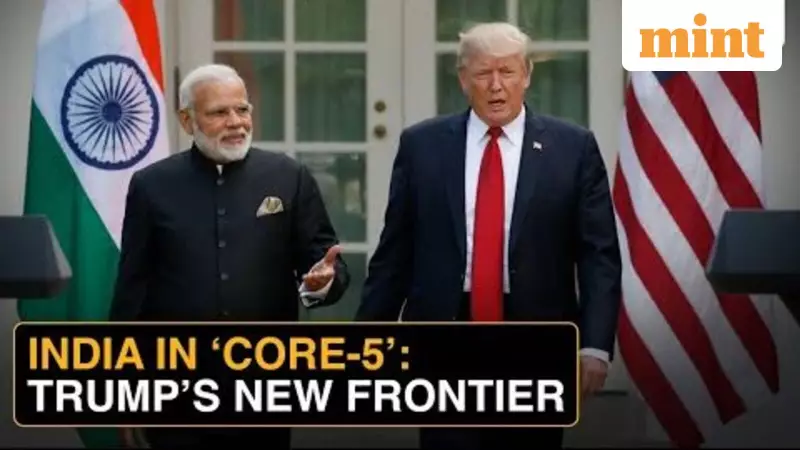
Former US President Donald Trump's reported secret foreign policy blueprint, dubbed the 'Core-5' or 'C5', is generating significant global discussion. The plan envisions a radical shift in international diplomacy by forming a new, exclusive club of powerful nations focused on hard power and direct deal-making.
What is the Core-5 Plan?
The proposal, as reported, aims to create a compact group of five major nations: the United States, Russia, China, Japan, and India. This concept seeks to move beyond the traditional, larger forums like the G7, which includes several European powers. The core idea is to bring together the world's most significant military and economic heavyweights to negotiate directly on pressing global issues.
The reported focus areas for this 'C5' group are security, trade, and critical regional matters like Middle East diplomacy, specifically mentioning fostering ties between Israel and Saudi Arabia. The philosophy appears to prioritize pragmatic realism and national interest over ideological alignment or promoting democracy, marking a potential fundamental change in how the US approaches global alliances.

Strategic Implications for India and the World
For India, inclusion in this proposed elite circle represents a substantial elevation of its global standing. Being named alongside permanent UN Security Council members and top economies signals a recognition of India as an indispensable, top-tier strategic player. This aligns with India's long-standing quest for a greater role in global governance.
Analysts suggest that such a forum could significantly boost India's strategic autonomy, allowing it to engage directly with both traditional partners and strategic competitors like China and Russia within a single, high-stakes framework. It places New Delhi at the heart of a potential new global order centered on hard power and bilateral deal-making.
Potential Risks and Global Reactions
However, the 'Core-5' proposal carries considerable risks and would face fierce opposition. By deliberately sidelining European allies like the UK, France, and Germany, the plan threatens to fracture NATO unity and undermine decades of transatlantic partnership. It signals a move away from value-based alliances toward purely transactional relationships.
The inclusion of both Russia and China, often viewed as adversaries by the West, in a US-led club is particularly controversial. It raises questions about the future of existing sanctions regimes and containment policies. Furthermore, the effectiveness of a group with such deeply divergent interests—from the US-China rivalry to the India-China border tensions—in reaching meaningful consensus remains highly uncertain.
The ultimate question, as global observers ponder, is whether this 'Core-5' concept could eventually replace or marginalize the G7 as the premier forum for Western-aligned economies. While still a proposal, its emergence from Trump's circle indicates a possible foreign policy direction that could reshape geopolitics, with India positioned in a uniquely pivotal role. The world watches to see if this secret plan becomes a tangible reality.






