

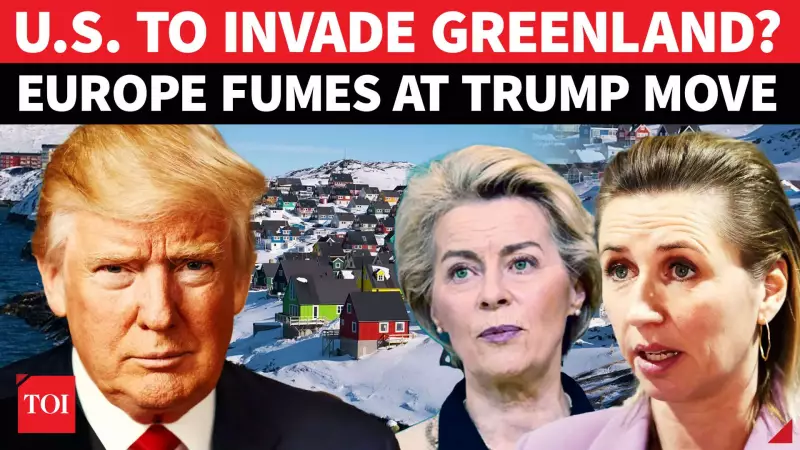
Former US President Donald Trump has ignited a major diplomatic firestorm in the Arctic by appointing a special envoy to Greenland. The move, perceived as a fresh assertion of American interest in the strategically vital island, has triggered immediate and fierce rejections from both Denmark and Greenland's local government.
Arctic Ambitions Spark Sovereignty Clash
The announcement, made on December 23, 2025, was met with swift condemnation. The government in Copenhagen, which handles Greenland's foreign and defense policy, labeled the US action as "unacceptable" and vowed to defend its sovereignty. Greenland's own Prime Minister delivered an even more direct rebuke, stating unequivocally that the island's future would be decided by its people alone, dismissing any talk of an external takeover.
This is not the first time Greenland has been at the centre of a geopolitical tussle during Trump's political career. His earlier, much-publicised interest in purchasing the island was widely mocked and rejected. The latest step of naming an official envoy, however, formalises this contentious interest, moving it from speculative comment to a point of diplomatic friction.

Strategic Stakes: Minerals and Missile Defence
Analysts point to two primary drivers behind Washington's persistent focus on Greenland. First, the island is believed to hold vast deposits of rare earth elements and other critical strategic minerals, resources essential for modern technology and green energy solutions, where the US seeks to reduce dependence on China.
Secondly, Greenland's geographic position makes it a crucial piece in the puzzle of global missile defence and Arctic security. As the Arctic ice melts, opening new shipping routes and resource exploration opportunities, the region's military significance has skyrocketed, drawing attention from major powers including the US, Russia, and China.
Allies in Conflict: Europe Pushes Back
The move has not only angered Denmark but has also drawn criticism from broader European allies. European Commission President Ursula von der Leyen was reported to have warned that "borders are not for sale," signalling a unified European rejection of the US claims. This public clash between traditional NATO allies marks a significant and explosive shift in Arctic geopolitics, where cooperation has often been tempered by underlying competition.
The situation creates a delicate balancing act for Europe, which must navigate its deep security ties with the United States while firmly defending the sovereignty of a European partner. The strong, unified response from Copenhagen, Nuuk (Greenland's capital), and Brussels indicates a clear red line has been crossed.
As the Arctic becomes a hotter theatre of great-power rivalry, Trump's provocative appointment ensures that the frozen north will remain a flashpoint, testing alliances and reshaping the strategic map in ways that extend far beyond the polar circle.






