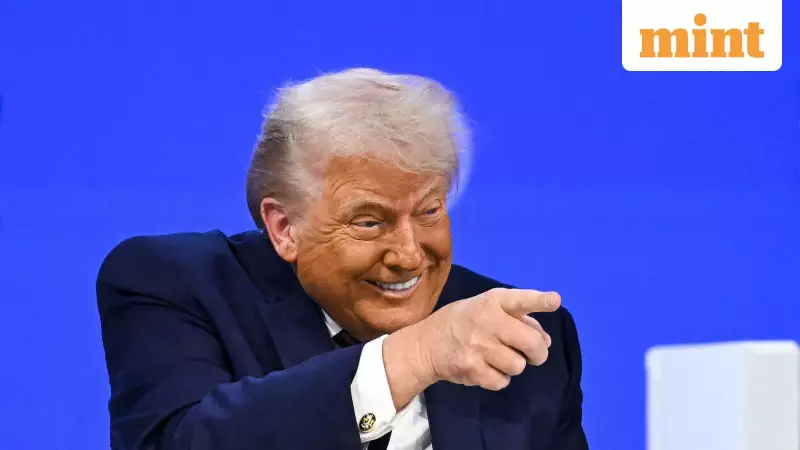
Global Alarm Over Trump's Greenland Threat Gives Way to Uncertainty Around Future Deal
President Donald Trump has stepped back from his aggressive push to acquire Greenland, but the diplomatic aftermath has left global observers grappling with significant uncertainty about what comes next. After days of intense international concern and market volatility, the U.S. president announced on Wednesday that he had established a framework for a future agreement regarding the icebound island, explicitly stating he would not use force to take control.
Diplomatic Whiplash and Vague Details
The sudden reversal followed what Trump described as a very productive meeting with NATO Secretary-General Mark Rutte in Davos, Switzerland. This encounter prompted the president to drop his earlier threat of imposing 10% tariffs on European nations that opposed his Greenland ambitions. However, the specifics of this newly formed framework remain remarkably hazy, with European officials on Thursday speaking only in broad, non-committal terms about the potential agreement.
This lack of clarity raises serious concerns that the recent chaos, which rattled financial markets and severely tested trans-Atlantic diplomatic relations, could easily resurface in the near future. The initial threat emerged when Trump arrived at the World Economic Forum arguing that Denmark, which holds sovereignty over Greenland, was incapable of defending the Arctic region from perceived Russian or Chinese aggression, making U.S. ownership a national-security imperative.

European Responses and Sovereignty Concerns
According to European officials briefed on the discussions, the anticipated negotiations may focus on a potential U.S. agreement with Denmark. This could involve stationing American forces at bases in Greenland and granting the United States a right of first refusal over investments in the island's vast mineral resources. However, NATO's Rutte clarified in an interview with Bloomberg that the sensitive issue of Greenland's sovereignty, which its autonomous government alongside Denmark has consistently defended, was not discussed at all during the talks with Trump.
We discussed how we can protect Greenland and the wider Arctic region, Rutte stated, emphasizing the security dimension over territorial claims. Meanwhile, Danish Prime Minister Mette Frederiksen remained steadfast, declaring that while Denmark is open to negotiations on political, security, and economic matters, the nation's sovereignty over Greenland is non-negotiable. She confirmed receiving assurances that this was not being contested.
Skepticism and Strategic Realignments
European skepticism about the substance of Trump's announced framework runs deep. One official revealed there is no written document, and no concrete details regarding Greenland's future were actually negotiated between Rutte and the president. Another suggested the meeting merely provided Trump with a face-saving opportunity to de-escalate a situation that had provoked a significant global backlash and alarmed financial markets.
This sentiment was echoed by Ben Wallace, a former U.K. defense secretary, who remarked, I don't think there's a deal at all at the moment. I mean, it's a sort of a fake deal so far. Despite this skepticism, German Chancellor Friedrich Merz welcomed Trump's policy shift in Davos. He indicated that under an informal understanding reached between Trump and Rutte, European NATO members would enhance their policing of the Arctic to counter Russian influence, a move he described as a serious response to a shared threat.
Focus on Arctic Security Over Resources
British Foreign Secretary Yvette Cooper added that, to her knowledge, discussions about access to Greenland's mineral riches were not part of the recent talks. This aligns with Trump's insistence in his Davos speech that his interest in Greenland was driven by military strategy, not the potential mineral wealth buried beneath its ice. Instead, Cooper noted the agreement appears centered on launching a NATO mission, tentatively called Arctic Sentry, aimed at bolstering defenses in the High North region.

In a pointed commentary, Chancellor Merz issued a veiled warning against the dangers of power politics, referencing Germany's own historical mistakes. He also cautioned that any new U.S. tariffs targeting European Union countries would be met with a measured but firm response. The path forward, he stressed, requires repairing the trust that forms the foundation of the trans-Atlantic alliance, a task made more urgent by the recent diplomatic turbulence.