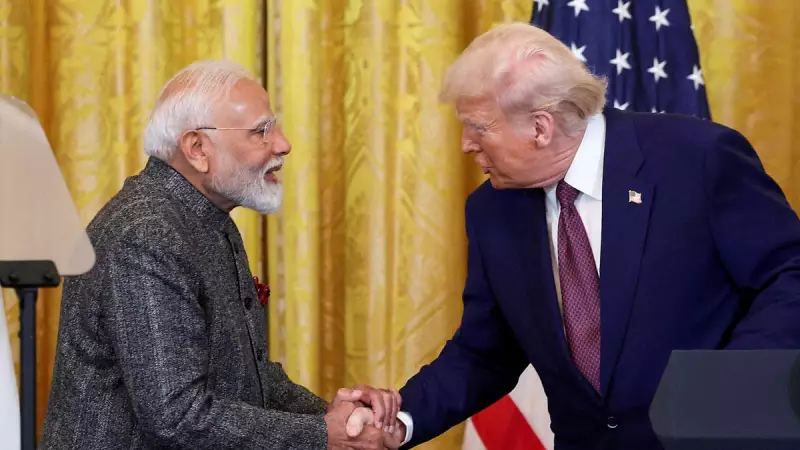
Former United States President Donald Trump has shared a new anecdote about his personal interactions with Indian Prime Minister Narendra Modi, using it to underscore the strength of their bilateral relationship. The revelation came amidst discussions on defence deals and trade policies.
The Personal Anecdote from a Former President
In his latest remarks, Donald Trump recalled a specific instance to illustrate his equation with the Indian leader. Trump quoted Prime Minister Modi as saying, "Sir, may I see you please," during an encounter. The former US President presented this detail not just as a casual memory, but as a testament to the mutual respect and access characterizing their dialogue.
Trump explicitly connected this personal rapport to substantive diplomatic and economic engagements between the two nations. "I have a very good relationship with him," Trump affirmed, directly linking the cordial interpersonal dynamic to broader state-level interactions.

Context: Defence Deals and Underlying Tensions
The anecdote was shared in the context of a significant defence acquisition. Trump pointed out that India had placed an order for 68 Apache attack helicopters, a major deal for the US defence industry. The narrative suggested that such high-value strategic agreements were facilitated by the positive relationship between the two leaders.
However, Trump also introduced a note of complexity to the otherwise warm portrayal. He added a caveat, stating, "but he is not happy with me." This brief admission hints at unresolved friction, widely interpreted as relating to ongoing trade and tariff issues where the two governments have not always seen eye to eye.
Implications for India-US Ties
This public recounting by a key figure in American politics serves multiple purposes. Firstly, it reinforces the image of a robust personal connection that has often been cited as a driver for the deepening strategic partnership between India and the US during that period.
Secondly, by mentioning the Apache deal, it highlights the concrete outcomes of this partnership in the realm of defence cooperation, where India remains a major partner for American equipment.
Finally, the hint of Modi's unhappiness acknowledges the real-world diplomatic challenges, particularly concerning trade imbalances and tariff wars, that persist despite strong leadership ties. It presents a nuanced picture where personal rapport exists alongside, and perhaps helps manage, inter-governmental disagreements on policy matters.
The story, originating from Trump's remarks on January 7, 2026, continues to generate discussion on the nature of diplomatic relationships, where personal dynamics between leaders can significantly influence, but not completely override, national interests and economic disputes.