

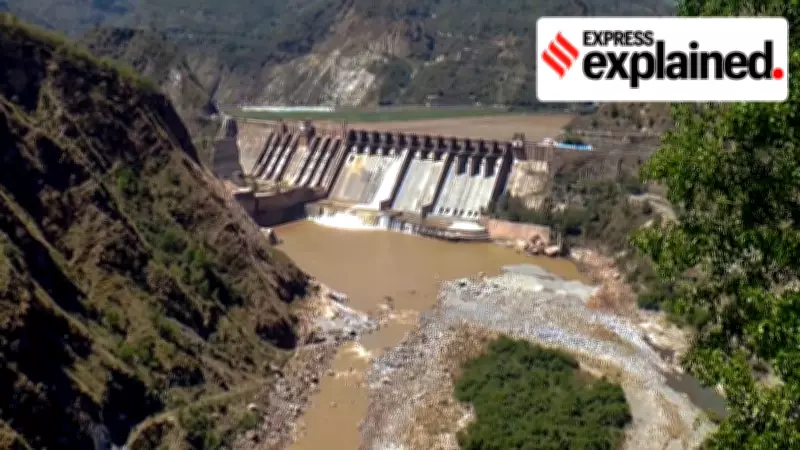
Tulbul Navigation Project Revival: J&K CM Confirms Efforts After Four-Decade Halt
In a significant development, Jammu and Kashmir Chief Minister Omar Abdullah has confirmed that his government is actively working with the Centre to revive the long-stalled Tulbul Navigation Project (TNP), also known as the "Wular Barrage." This announcement comes after the project has remained in limbo for nearly four decades, primarily due to objections from Pakistan under the Indus Waters Treaty (IWT) and the eruption of militancy in the Kashmir Valley in 1989.
Project Origins and Historical Context
The Tulbul Navigation Project was first conceived in the 1980s, with construction commencing in 1984. The primary objective was to ensure a uniform flow of water in the Jhelum River throughout the year, thereby facilitating navigation. The Jhelum is one of three rivers in the Kashmir Valley that fall under the purview of the now-suspended Indus Waters Treaty.
The project envisioned a lock-and-control structure at the confluence of the Jhelum River and Wular Lake in Sopore, north Kashmir. This hydraulic structure, planned to be 135 meters long and approximately 12 meters wide, aimed to store 30,000 acre-feet of water during high-discharge periods and release it during low-discharge periods to maintain consistent water levels.

Pakistan's Objections and Militancy Impact
Pakistan raised objections to the project, arguing that controlling the Jhelum's water flow could be used as a "weapon" to induce droughts or floods in Pakistan. Although India briefly resumed work in the late 1980s, the rise of militancy in the Valley led to the project becoming a target. Militants, allegedly acting on Pakistan's directions, forced workers to abandon the site, and a significant amount of iron and machinery was looted. Consequently, work on the TNP came to a complete halt for the next three decades.
Recent Developments and Political Reactions
Chief Minister Omar Abdullah's statement in the J&K Legislative Assembly on February 10 highlighted ongoing efforts to revive not only the Tulbul Navigation Project but also a project to lift water from the Chenab River near Akhnoor for supply to Jammu city. He expressed optimism that work on both initiatives would commence soon.
This revival push follows the Centre's suspension of the Indus Waters Treaty in May 2025, in response to a terror attack in Pahalgam and a subsequent conflict with Pakistan under Operation Sindoor. Abdullah had previously questioned whether the Centre would initiate work on the TNP post-suspension.
However, the move has drawn criticism from former Chief Minister and Peoples Democratic Party president Mehbooba Mufti, who labeled Abdullah's call to revive the project as "deeply unfortunate" and "dangerously provocative." Mufti emphasized the risks of weaponizing water and internationalizing bilateral issues, especially in the aftermath of recent conflicts.
Conservation Efforts and Setbacks
In 2010, the J&K government launched the centrally sponsored Rs 389-crore "Wular Conservation Project" in Sopore, supervised by the state Irrigation and Flood Control Department. This initiative aimed to enhance tourism, increase fodder production for animals, and boost fish and water chestnut yields in the lake.
Unfortunately, the project faced setbacks when militants raided workers' huts in January 2012, stealing documents and maps. In August of the same year, militants returned, damaging under-construction retention walls, sluice gates, and workers' huts, further halting progress.
Future Prospects and Implications
The revival of the Tulbul Navigation Project represents a critical step in addressing long-standing infrastructural and navigational needs in Jammu and Kashmir. With the Indus Waters Treaty currently in abeyance, the path may be clearer for resuming work, though political and security challenges remain.
As efforts progress, the project's success could significantly impact regional development, water management, and bilateral relations with Pakistan. Stakeholders will be closely monitoring the situation to see if work finally resumes after four decades of delays and disruptions.






