

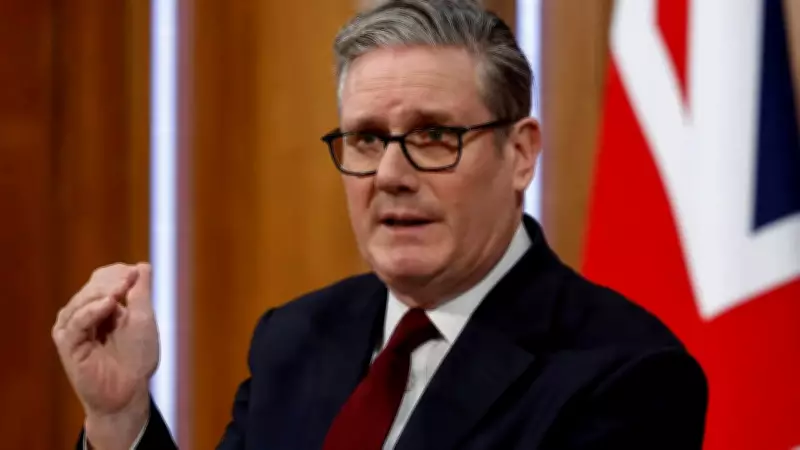
UK Prime Minister Keir Starmer Rules Out Deeper Military Involvement in Middle East Conflict
UK Prime Minister Keir Starmer declared on Monday that Britain "will not be drawn into the wider war" currently raging in the Middle East. This statement comes even as his government collaborates with the United States, European partners, and Gulf allies to develop a "viable collective plan" aimed at reopening the strategically vital Strait of Hormuz. This critical energy chokepoint has been severely disrupted by the ongoing regional conflict, causing significant global economic tremors.
Starmer Emphasizes Diplomatic and Collective Approach
Speaking at a press conference held at 10 Downing Street, Prime Minister Starmer underscored the essential nature of reopening the strait to restore normal shipping flows and stabilize volatile global markets. However, he was quick to temper expectations, stressing that this would be a difficult and complex task and would categorically not involve a NATO-led military mission.
"I want to see an end to this war as quickly as possible. Because the longer it goes on, the more dangerous the situation becomes," Starmer stated, making his government's priority clear. He affirmed that while Britain would actively support international efforts to restore freedom of navigation in the region, it would steadfastly avoid being pulled into a broader, more direct regional military confrontation.

Coordinating a "Viable Collective Plan" with Allies
The Prime Minister detailed that Britain is deeply engaged in coordination with its allies to formulate a workable strategy to restore safe passage through the Strait of Hormuz. "We're working with all of our allies, including our European partners, to bring together a viable collective plan that can restore freedom of navigation in the region as quickly as possible and ease the economic impacts," he explained, as reported by the AFP news agency.
Discussions are reportedly focused on practical measures, including the potential use of mine-hunting drones that the UK already has deployed in the region. Starmer signaled that London is unlikely to commit a warship to the effort, describing the overall undertaking as, "to say the least, not easy."
Explicitly Ruling Out a NATO Mission
In a definitive move, Prime Minister Starmer explicitly ruled out any NATO-led operation to secure the strait. This position comes after US President Donald Trump publicly warned that the alliance faced a "very bad" future if member states did not contribute to securing the critical waterway.
"Let me be clear, that won't be and it's never been envisioned to be a NATO mission," Starmer told reporters. He clarified that any future operation would instead have to be constituted as "an alliance of partners" rather than a formal NATO deployment. This stance aligns with a broader European reluctance to frame the crisis as a NATO war, with Germany also insisting the conflict was "not NATO's war."
UK-US Relations and International Pressure
Starmer noted that he maintains a strong relationship with President Trump, having spoken to him on Sunday about the Strait of Hormuz and the broader Middle East situation. "It's a good relationship... We are strong allies, have been for decades. But it is for me to act in what I consider to be in the best interest of Britain," he stated, as per PTI reports.
This diplomatic balancing act occurs against a backdrop of Trump publicly urging several allies, including Britain, to contribute military assets to reopen the strait. However, the response from allied capitals has been notably cautious. Countries like Poland, Spain, Japan, and Australia have signaled reluctance or outright ruled out military participation, with the European Union exploring alternative diplomatic and naval mission expansions instead.
Economic Fallout and Regional Tensions
The continued closure of the Strait of Hormuz remains central to the conflict's severe economic fallout. Oil prices remained above $100 per barrel on Monday as the war entered its third week, highlighting the urgent need to restore tanker access. Approximately one-fifth of the world's traded oil normally transits through this narrow passage.

The wider regional security picture remains intensely tense. Reports indicate ongoing attacks, including a recent drone strike on Dubai International Airport and missile and drone assaults from Iran targeting the UAE. Iranian officials, however, have maintained that the strait is only closed to the US, Israel, and their allies.
Prime Minister Starmer's firm position reflects his government's consistent line of seeking de-escalation and resisting pressure for a more direct British combat role, emphasizing that British military force should only be committed where action is legal and backed by a thoroughly considered plan.





