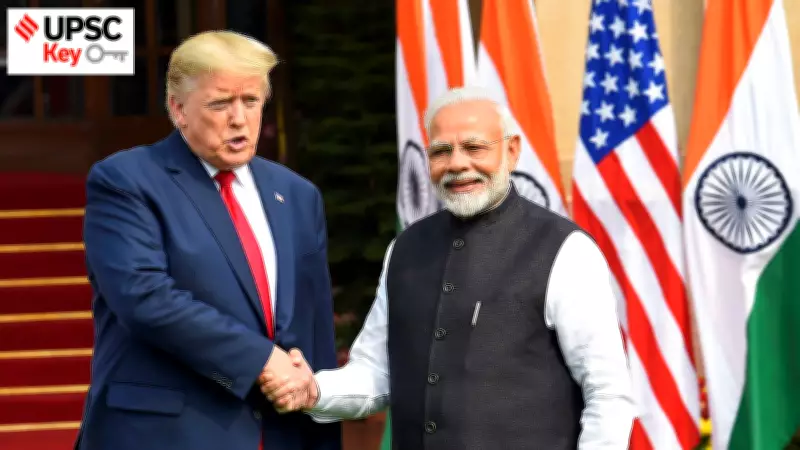
India-US Trade Deal: A Strategic Milestone for UPSC Preparation
The recent finalisation of the India-US trade deal marks a pivotal moment in bilateral relations, with Washington reducing reciprocal tariffs on Indian goods to 18 per cent from 25 per cent. This development is crucial for UPSC aspirants as it intersects with multiple exam syllabi, including current events, international agreements, and economic policies.
Why the India-US Trade Deal Matters for UPSC
This trade agreement reinforces India's role as a key ally and counterweight to China in the global trade order. For the Preliminary Examination, it highlights current events of national and international importance. In the Mains, it pertains to General Studies-II and III, covering bilateral groupings, economic growth, and resource mobilisation.
Key points to ponder include:

- The significance of the deal in enhancing India's access to the American market.
- Its impact on Foreign Portfolio Investors (FPIs) and foreign direct investment (FDI) inflows.
- The shift in India's oil import strategies, particularly from Russia to alternatives like the US and Venezuela.
- How the deal aligns with the China+1 strategy, benefiting India's economic prospects.
The deal also addresses previous challenges, such as US tariffs on Indian goods, which had led to a decline in exports. With this agreement, India's position improves against competitors like Vietnam and China, potentially boosting trade and investment.
16th Finance Commission: Navigating Fiscal Challenges
The 16th Finance Commission has issued critical recommendations focusing on state finances and subsidy management. Its report, tabled in Parliament, warns against the surge in unconditional cash transfer schemes, which could destabilise state budgets.
Relevance for UPSC Exams
For the Preliminary Examination, this topic covers Indian Polity and Governance, including constitutional bodies and public policy. In the Mains, it relates to General Studies-II and III, addressing functions of constitutional bodies, federal structure, and economic planning.
Key takeaways include:
- The Commission's call for sunset clauses in cash transfer schemes to ensure fiscal prudence.
- Recommendations for privatising power distribution companies (discoms) to address financial stress.
- Changes in horizontal tax devolution, increasing shares for southern states like Tamil Nadu and Karnataka.
- The emphasis on rationalising subsidies and avoiding off-budget borrowings.
These insights are vital for understanding India's fiscal governance and preparing for questions on finance commissions and economic policies.
India-Arab Delhi Declaration: Strengthening International Ties
India hosted the second India-Arab Foreign Ministers Meeting, resulting in the Delhi Declaration. This joint statement addresses regional conflicts and enhances cooperation on issues like sovereignty and territorial integrity.
UPSC Implications
This declaration is relevant for both Preliminary and Mains exams, covering current events and international groupings. It highlights India's diplomatic engagements and strategic interests in the Middle East.
Important aspects include:
- Support for the Arab Peace Initiative of 2002, advocating a two-state solution for Israel-Palestine.
- Condemnation of Houthi attacks in the Red Sea, aligning with regional security concerns.
- Emphasis on non-interference in internal affairs of countries like Sudan, Somalia, and Libya.
- The omission of the US-led Board of Peace, reflecting India's cautious diplomatic stance.
Understanding this declaration helps aspirants grasp India's foreign policy dynamics and its role in global affairs.
Essential Practices Doctrine and Char Dham Proposal
A proposal to ban non-Hindus from Char Dham temples in Uttarakhand has sparked debates on constitutional rights. This issue ties into the Essential Religious Practices doctrine, which determines what practices are integral to a religion.
UPSC Connection
For the Preliminary Exam, this covers Indian Polity and current events. In the Mains, it relates to General Studies-II, focusing on constitutional provisions and secularism.

Key considerations:
- The constitutional balance between freedom of religion (Articles 25 and 26) and the right to move freely (Article 19).
- How the Essential Practices doctrine, established in the Shirur Mutt case, applies to temple entry bans.
- Comparisons with similar cases, like the Sabarimala temple judgment, which allowed women's entry.
This topic is essential for questions on fundamental rights and religious freedoms in India.
Additional Current Affairs for UPSC
Other notable developments include the impact of AI data centres on commodity prices, affecting industries like automotive, and legal challenges to WhatsApp's encryption policies. These issues highlight the intersection of technology, economy, and governance, relevant for UPSC's dynamic syllabus.
By integrating these topics into your study plan, you can enhance your understanding of contemporary issues and improve exam performance. Stay updated with reliable sources and practice answer writing to master these concepts.