

UPSC Key Insights: Critical Minerals, Carbon Capture, and Global Diplomacy
For UPSC aspirants, staying updated with current affairs is crucial for both the Preliminary and Main examinations. The Indian Express UPSC Key for February 5, 2026, highlights several important topics, including External Affairs Minister S. Jaishankar's talks in Washington, the significance of critical minerals, guidelines on Disaster Victim Identification, carbon capture technologies, and the expiration of the New START Treaty. This analysis delves into these issues, explaining their relevance to the UPSC syllabus and providing key takeaways for exam preparation.
Energy and Critical Minerals in Focus During Jaishankar's Washington Visit
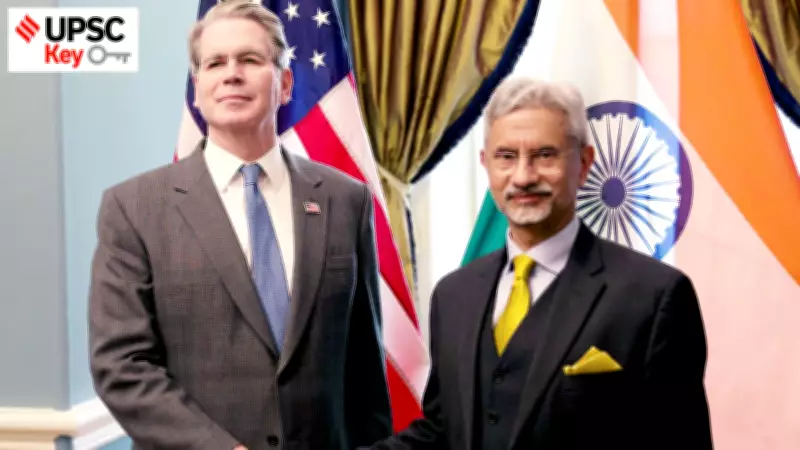
External Affairs Minister S. Jaishankar's meetings in Washington DC with US Secretary of State Marco Rubio and Treasury Secretary Scott Bessent focused on energy security and critical minerals. This topic is vital for UPSC aspirants as it aligns with the Preliminary Examination's current events section and the Mains Examination's General Studies-II and III, covering bilateral agreements and India's economic interests.
Key Points to Consider:

- The significance of critical minerals in India's economic and strategic planning.
- Announcements in the Union Budget 2026 regarding critical minerals and rare earth corridors.
- Major agreements signed by India to secure critical mineral supply chains.
- The role of the National Critical Minerals Mission in enhancing India's self-reliance.
Key Takeaways:
- Jaishankar emphasized the importance of de-risking supply chains through international cooperation at the inaugural critical minerals ministerial meeting.
- India's purchase of Russian oil has declined due to US tariffs, shifting focus to alternative energy sources.
- The Quad alliance remains a key platform for India-US cooperation in the Indo-Pacific region.
- Budget 2026-27 proposed dedicated rare earth corridors in coastal states like Odisha, Kerala, Andhra Pradesh, and Tamil Nadu.
NDMA's Guidelines for Disaster Victim Identification
The National Disaster Management Authority (NDMA) released its first-ever Standard Operating Procedure for identifying victims in mass fatality incidents. This topic is relevant for the Preliminary Examination's current events and Mains Examination's General Studies-III on disaster management.
Key Points to Consider:
- The roles and functions of NDMA in disaster response.
- The need for SOPs to address gaps in victim identification during disasters.
- India's vulnerability to various forms of disasters and existing management mechanisms.
Key Takeaways:
- The guidelines recommend creating a National Dental Data Registry for victim identification.
- Forensic archaeology techniques are included to identify bodies months or years after disasters.
- The SOP addresses logistical challenges like mortuary spaces and cold chain transport.
- Initiatives like the Coalition for Disaster Resilient Infrastructure (CDRI) and Infrastructure for Resilient Island States (IRIS) highlight India's global role in disaster resilience.
Carbon Capture Technologies for Achieving Net-Zero Goals
The Union Budget 2026 allocated Rs 20,000 crore for carbon capture, utilisation, and storage (CCUS) solutions over five years. This topic is essential for the Preliminary Examination's economic and social development section and Mains Examination's General Studies-II and III on environmental policies.
Key Points to Consider:
- The three stages of CCUS: capture, utilisation, and storage.
- The feasibility of CCUS in hard-to-abate sectors like steel and cement.
- Policy frameworks needed to support CCUS deployment in India.
Key Takeaways:

- CCUS technologies are critical for India to achieve its net-zero emissions target by 2070.
- Pilot projects in steel, cement, and chemicals industries are already operational.
- The budgetary allocation aims to bridge funding gaps for field testing and scaling up CCUS technologies.
- CCUS can help Indian industries comply with international carbon tariffs like the EU's Carbon Border Adjustment Mechanism (CBAM).
Expiration of the New START Treaty and Global Nuclear Dynamics
The New START Treaty, the last nuclear arms pact between Russia and the US, expired, raising concerns about a potential arms race. This topic is relevant for the Preliminary Examination's current events and Mains Examination's General Studies-II on global agreements.
Key Points to Consider:
- The history and limits imposed by the New START Treaty.
- Compliance mechanisms and the treaty's role in global nuclear arms control.
- Implications of its expiration for international security.
Key Takeaways:
- The expiration removes caps on the world's largest nuclear arsenals for the first time in decades.
- Russia expressed willingness to extend the treaty if the US follows suit, but the US response remains uncertain.
- Experts warn that failure to renew the treaty could lead to an unconstrained nuclear arms race involving China.
- This development underscores the importance of diplomatic efforts in maintaining global stability.
Additional UPSC-Relevant Topics
Supreme Court on Tamil Nadu V-C Appointment Bills: The Supreme Court set aside a Madras High Court order staying Tamil Nadu's laws on Vice-Chancellor appointments, highlighting issues in federal structure and constitutional posts. This aligns with Mains Examination's General Studies-II on governance.
India-Pakistan Relations: Shashi Tharoor's analysis emphasizes the need for dialogue and people-to-people engagement despite security challenges. This topic is relevant for Mains Examination's General Studies-II on bilateral relations.
Matrimonial Site Scam Case: The Supreme Court's interim protection for Shaadi.com's founder raises questions about platform liability under the IT Act, pertinent for current events and legal studies.
Budget Criticism: Analysis by Himanshu argues that the Budget may deepen inequality due to expenditure cuts in key sectors, relevant for economic and social development topics.
High-Speed Rail Corridors: Announcements of new bullet train corridors aim to enhance India's self-reliance in infrastructure, aligning with economic planning and development themes.
In conclusion, these topics from the UPSC Key for February 5, 2026, provide a comprehensive overview of current affairs essential for exam preparation. Aspirants should focus on understanding the interconnections between diplomacy, economy, environment, and governance to excel in both Preliminary and Main examinations.





