

The $3.4 Trillion China Rivalry: A Blueprint for US-India Relations
A staggering $3.4 trillion has been quietly funneled by the United States into a militarized rivalry with China between 2012 and 2024, according to a comprehensive report from Brown University's Costs of War project. This colossal expenditure, averaging $260 billion annually, eclipses the $2.3 trillion spent during two decades of war in Afghanistan, yet it occurred without a single shot fired in direct combat between the two superpowers.
Peacetime Paranoia: The Anatomy of $3.4 Trillion
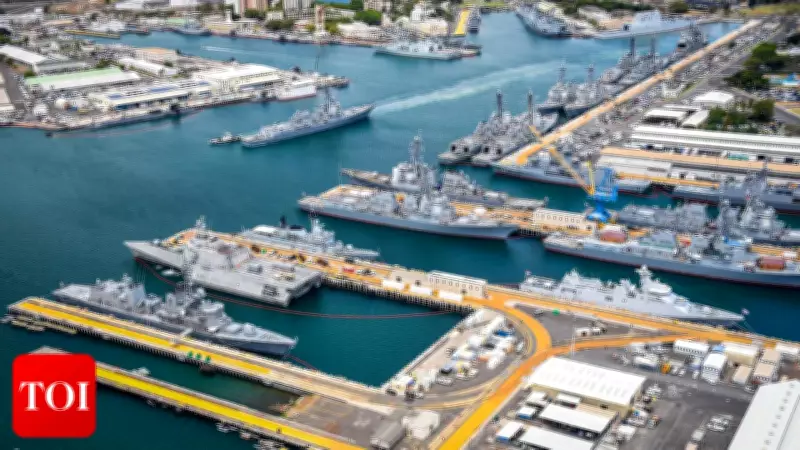
The report details how this spending, representing 5% of total federal outlays and 14% of discretionary funds, was dominated by Pentagon priorities. Navy and Marine Corps expenditures led at 33% ($1.13 trillion), driven by frantic shipbuilding and munitions stockpiling to counter China's world-largest navy in the Indo-Pacific maritime theater.
Defense agencies, including the Missile Defense Agency and Joint Staff, consumed 25% ($850 billion), highlighting bloated operational costs beyond frontline weapons. Air and Space Forces accounted for 15%, the Army for 14%, with smaller sums allocated to intelligence and military bases.

The Trigger: Obama's Pivot to Asia
This militarized rivalry did not erupt overnight but simmered through decades of uneasy engagement. It ignited in November 2011 when President Barack Obama delivered a fateful speech to Australia's parliament, declaring, "The United States is a Pacific power, and we are here to stay." This formalized the "pivot to Asia," marking a seismic reorientation of American grand strategy from Middle East conflicts toward Beijing's gathering storm.
By 2012, Beijing was designated a "pacing threat"—the Pentagon's term for the challenge dictating every budget line, from hypersonic missiles to AI warfare technology. Fast-forward to 2026, and Secretary of State Marco Rubio describes US-China tensions as "the story of the 21st century," echoing bipartisan hawks who view China's military rise as an existential red line in the Indo-Pacific.
The Bigger Picture: Strategic Dissonance and Fiscal Reckoning
Despite President Donald Trump's second-term pivot toward Western Hemisphere priorities—fortifying the southern border and countering Latin American instability—China remains the Pentagon's unshakeable "pacing ghost." This strategic benchmark continues to dictate weapons procurement, training regimens, and budget justifications across all services, with the Department of Defense's 2026 posture documents still framing the Indo-Pacific as the priority theater.
There exists a cognitive dissonance: $3.4 trillion spent from 2012 to 2024, yet no off-ramp in sight. In a Trump-era Washington obsessed with "America First" fiscal restraint, these numbers demand reckoning, especially as deficits swell past $40 trillion.
Learning from 'Mistakes': The China Engagement Model
Recent vows by US officials not to repeat "mistakes" with India refer to perceived policy missteps toward China that enabled its transformation from an economic laggard to a military-economic superpower. Analysts debate these errors, centering on over-engagement without safeguards and underestimating Beijing's strategic intent.
After Beijing's crackdown on pro-democracy protests in the 1980s, the US imposed brief sanctions but quickly pivoted to "constructive engagement." Critics argue this missed a chance to isolate China economically, potentially stunting its growth. Instead, Washington prioritized business ties.
President Bill Clinton's push to admit China to the World Trade Organization (WTO) and grant Permanent Normal Trade Relations (PNTR) is heavily criticized. Proponents claimed it would force market reforms and liberalization, but in reality, the US-China trade deficit exploded from $83 billion in 2000 to $345 billion in 2019, costing an estimated 3.7 million American jobs via offshoring.
US firms flooded China with investments, outsourcing manufacturing and sharing proprietary technology. Beijing mandated joint ventures, forced intellectual property handovers, and reverse-engineered everything from F-35-inspired J-20 jets to solar panels, fueling today's $3.4 trillion rivalry.

Implications for India: Managed Engagement and Strategic Conditions
To prevent India from repeating China's trajectory—from US partner to "pacing threat"—experts believe Washington will pursue a policy of "managed engagement." This involves tying technology transfers, such as jet engines and drones, arms deals, and market access to strict conditions like reduced Russian imports, Quad interoperability, and robust intellectual property safeguards.
The US is likely to file more WTO challenges against India's Production Linked Incentive (PLI) subsidies, which it argues violate international trade rules. It may also demand duty waivers, localization exemptions, and impose selective tariffs unless Delhi aligns supply chains with US priorities.
Trump 2.0's "no mistakes" mantra means conditioning high-tech devices and semiconductor plants on firewall protections against reverse-engineering, fearing joint venture traps that birthed China's J-20 from F-35 know-how and its entire technology cloning economy.
Indian officials have indicated firm defense of incentive schemes. "Without schemes like PLI, revival of manufacturing looks difficult," said Biswajit Dhar, a New Delhi-based independent trade economist and former professor at Jawaharlal Nehru University.
In its larger rivalry with China, the US views India as a counterweight—not a peer—setting the stage for a more complex and potentially contentious partnership that could make India's rise far tougher than anticipated.





