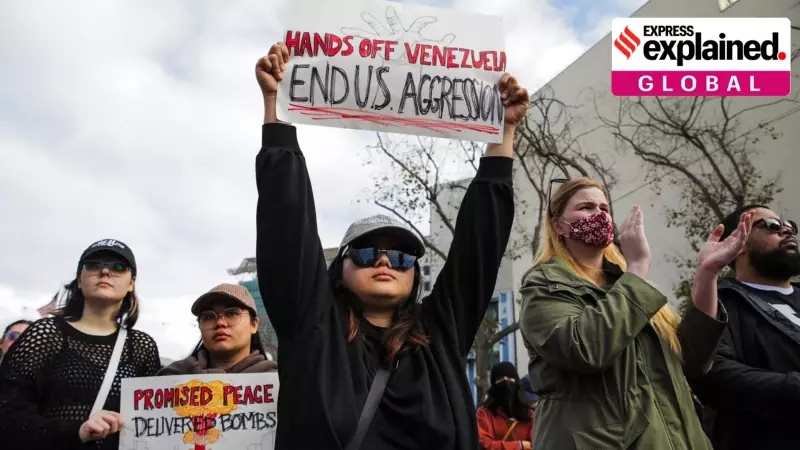
In a dramatic escalation that has sent shockwaves through the international community, the United States has conducted a military operation in Venezuela, resulting in explosions over Caracas and the capture of the country's President, Nicolás Maduro, along with his wife. The incident, which occurred on January 3, 2026, was confirmed by US President Donald Trump, who described it as a "large-scale" action. Venezuelan authorities have declared a national emergency, labelling the event a direct attack on their sovereignty.
The Legal Quagmire: From Policing to Warfare
The core legal issue is stark. The UN Charter explicitly forbids the use of force, with only two narrow exceptions: authorization by the Security Council or self-defence against an armed attack. The US justification appears to hinge on labelling Venezuela's alleged involvement with narcotics networks as "narco-terrorism". However, international law experts argue that this rebranding does not automatically lower the legal threshold for cross-border military action.
This situation stress-tests three fundamental principles of self-defence. First, can narco-terrorism be considered an "armed attack"? Traditionally, no. Transnational crime, however grave, is not equivalent to the scale of violence envisioned by Article 51 of the UN Charter. Second, was force a necessity? The law requires that non-forcible options like cooperation, extradition, or financial sanctions be explored or deemed unviable. Third, was the response proportionate? The capture and removal of a sitting head of state moves the action beyond repelling an immediate threat and into the realm of political coercion, raising serious proportionality concerns.

A Sovereign Breach: The Capture of a Head of State
The seizure of President Maduro presents a distinct and severe legal challenge. Conducting a cross-border arrest operation on Venezuelan soil without its consent constitutes a clear breach of sovereignty under Article 2(4) of the UN Charter. Framing it as "law enforcement" executed by military means blurs a critical line. This act transforms the operation from a defensive strike into what appears to be prosecution by force, setting a perilous precedent where powerful states can militarily extract individuals from other nations.
Why This Venezuelan Precedent Matters Deeply to India
For India, this incident is not a distant geopolitical drama but a case study with direct implications. India holds dual strategic interests. On one hand, it faces genuine threats from cross-border terrorism and violent non-state actors misusing neighbouring territories. On the other, as a rising power that values a stable, rules-based order, India has a vested interest in keeping the threshold for lawful use of force high and unambiguous.
The danger lies in the slippery slope this event represents. If "crime" can be reclassified as an "armed attack" justifying bombs, and if "capture for prosecution" can override sovereignty, these tools will not remain confined to the Americas. The precedent empowers states with global military reach, potentially destabilising the entire international system. The stakes transcend opinions on Maduro; they are about maintaining the clear distinctions between defence and punishment, war and policing, and legal sovereignty versus raw power.
The regional reaction underscores the gravity of the situation. Colombia's President Gustavo Petro has called for urgent meetings of the UN Security Council and the Organisation of American States (OAS), indicating that Latin America views this as a fundamental challenge to regional stability and international law.