

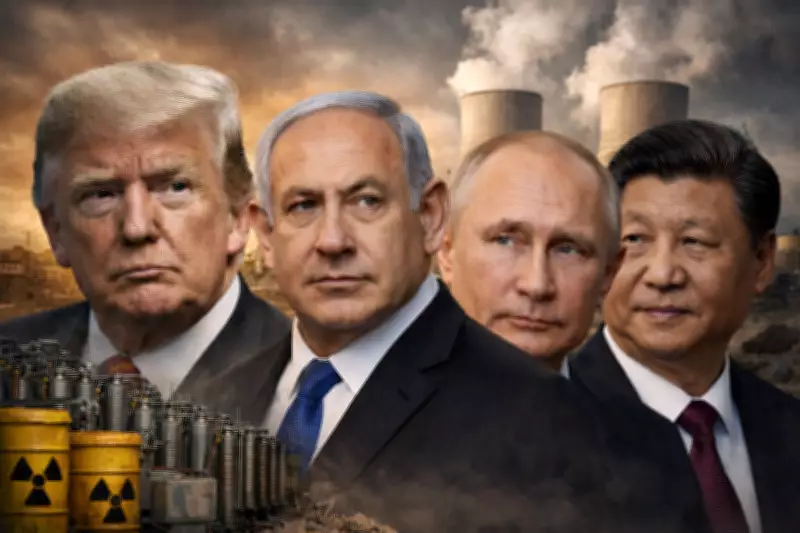
Global Powers Locked in Intense Struggle Over Iran's Uranium Stockpile
The enriched uranium reserves held by Iran have emerged as a critical flashpoint in a complex global geopolitical contest, drawing intense interest from the United States, China, and Russia. Each nation is aggressively positioning itself to influence the future disposition of this highly sensitive nuclear material, while the Iranian government maintains an unwavering stance that it will not surrender the stockpile to any foreign power.
From Technical Issue to Political Powder Keg
What originated as a specialized topic within nuclear non-proliferation discussions has rapidly transformed into one of the most politically charged and strategically significant questions dominating contemporary international relations. For Washington, establishing control over Iran's uranium represents a crucial mechanism to obstruct any potential pathway toward nuclear weapons development. Moscow and Beijing perceive the situation as a golden opportunity to expand their influence over the eventual political and security architecture of the Middle East. For Tehran, the enriched uranium symbolizes national sovereignty, provides substantial strategic leverage in negotiations, and embodies a profound sense of technological achievement and national prestige.
Trump's "Nuclear Dust" Claim and Iran's Swift Rejection
The issue erupted back into the international spotlight following assertions by former US President Donald Trump that Washington and Tehran were progressing toward an unprecedented agreement. Trump claimed this deal would involve the recovery and eventual transportation of Iran's uranium to American soil.

In a detailed phone interview with Reuters, Trump elaborated on this vision, stating, "We're going to get it together. We're going to go in with Iran, at a nice leisurely pace, and go down and start excavating with big machinery. We'll bring it back to the United States." He further described the material as "nuclear dust" and predicted its recovery would occur "very soon."
Iranian officials issued an immediate and categorical rejection of these claims. Iranian Foreign Ministry spokesperson Esmaeil Baghaei declared, "Iran's enriched uranium is not going to be transferred anywhere; transferring uranium to the United States has not been an option for us." This sharp contradiction has laid bare one of the central unresolved disputes in ongoing negotiations, which are reportedly being mediated by Pakistan with support from Egypt and Turkey.
Understanding the Strategic Value of Iran's Uranium
The immense global attention on Iran's uranium stems from its potential military applications. Natural uranium cannot be directly used in nuclear weapons; it must first undergo enrichment to increase the concentration of the fissile uranium-235 isotope.
- Low-enriched uranium (typically up to 5% purity) is commonly used to fuel civilian nuclear power reactors.
- Highly enriched uranium (above 20% purity) can potentially be used in the core of a nuclear weapon.
Western intelligence assessments, cited in international reports, estimate Iran's stockpile includes:
- Approximately 450 kilograms enriched to 60% purity.
- Roughly 1,000 kilograms enriched to 20% purity.
- About 8,500 kilograms enriched to 3.6% purity.
The stockpile enriched to 60% is considered especially sensitive and dangerous. It is regarded as being only a short, technical step away from reaching weapons-grade enrichment levels of around 90%. This proximity to bomb-making capability makes Iran's uranium one of the most closely monitored nuclear stockpiles on the planet. Iran consistently denies any intention to develop nuclear weapons, asserting that all its nuclear activities are exclusively for peaceful civilian purposes.
Decoding the "Nuclear Dust" Terminology
Trump's use of the phrase "nuclear dust" is not a recognized scientific or technical term. Analysts interpret it as a political descriptor for uranium material that he believes remains buried, damaged, or dispersed following previous military strikes on Iranian nuclear infrastructure, particularly near Isfahan.

Experts clarify that uranium does not simply vanish after a facility is struck. Depending on storage conditions, it can remain recoverable within containers, sealed chambers, buried debris, or damaged tunnels. This explains Trump's reference to excavation with "big machinery." In practical terms, "nuclear dust" refers to residual nuclear material that retains significant strategic value even if the surrounding facilities were destroyed.
Motivations Driving the Global Powers
United States: For Washington, physically removing Iran's uranium stockpile is viewed as the most direct method to cripple Tehran's ability to rapidly advance toward a nuclear weapon. Trump framed the potential deal as evidence his administration could secure a far more robust arrangement than previous nuclear agreements. He portrayed it as a major diplomatic victory and a core national security achievement, stating Iran had agreed to "a very, very powerful statement... that they will not have nuclear weapons."
Russia: The Kremlin has publicly renewed its offer to host Iran's enriched uranium under a future settlement, reviving a role it played in the 2015 nuclear deal. Kremlin spokesperson Dmitry Peskov confirmed, "This proposal was voiced by President Putin... The offer still stands." For Moscow, custodianship of the stockpile would restore its influence in nuclear diplomacy, expand its relevance in the Middle East, and solidify its position as an indispensable intermediary between Washington and Tehran.
China: Beijing has emerged as another potential player, with diplomatic reports indicating China is open to taking custody of the uranium or down-blending it to lower, civilian-use enrichment levels if all parties agree. China's interest is both strategic and economic. As Iran's largest trading partner and top oil buyer, Beijing has strong incentives to prevent further Gulf conflict and ensure stable energy flows through the Strait of Hormuz. A mediating role would also significantly boost China's diplomatic standing globally.
Iran's Unyielding Position and Implementation Challenges
For Iran, the uranium issue transcends nuclear science; it is deeply intertwined with domestic politics, national prestige, and sovereignty. Iranian leaders have long portrayed the indigenous enrichment capability as a symbol of technological progress and resistance to foreign coercion. Analysts note that surrendering the stockpile to the United States would be politically indefensible within Iran.
Professor Ali Ansari explained to the Guardian, "Iran's attachment to uranium enrichment is deeply ideological. It is almost an obsession with national prestige." Even if Tehran accepted inspections or monitoring, physically handing over the uranium could be perceived internally as a humiliating capitulation, explaining the immediate rejection of Trump's claims.
Furthermore, even if a political agreement were miraculously reached, the physical extraction of the material presents a monumental challenge. With some uranium believed stored in underground tunnels or damaged facilities, any retrieval mission would require complex excavation, secure transport under extreme radiation precautions, and rigorous international verification. One expert starkly warned, "You've got basically a half ton of what's effectively weapons-grade uranium that you've got to extricate. And there are a million things that could go wrong." Implementation could take weeks or months following any diplomatic breakthrough.
Controversy Over a $20 Billion Report and the Path Forward
Additional controversy erupted following an Axios report suggesting the United States had considered releasing $20 billion in frozen Iranian assets in exchange for Tehran relinquishing its uranium stockpile. The report indicated Washington had earlier been prepared to release $6 billion for humanitarian purposes, while Iran sought $27 billion.
Trump vehemently denied any financial component to the arrangements, stating, "It's totally false. No money is changing hands," and later reiterating the point on Truth Social. A White House spokesperson added that the administration would "not negotiate through the press" and dismissed anonymous sources.
Negotiators are expected to continue talks in the coming days, but the uranium dispute remains the clearest barometer for whether a broader settlement is achievable. Washington seeks ironclad guarantees that Iran cannot quickly move toward a bomb. Iran demands comprehensive sanctions relief, security assurances, and recognition of its right to peaceful nuclear energy. Russia and China see a prime opportunity to shape the outcome.
Whether Iran's uranium is ultimately removed, diluted, stored abroad, or retained under strict international monitoring will likely determine whether this round of diplomacy succeeds or collapses entirely. For now, a single stockpile of enriched uranium has become the strategic prize that three global superpowers desperately want, and the one asset the Iranian government absolutely refuses to surrender.





