

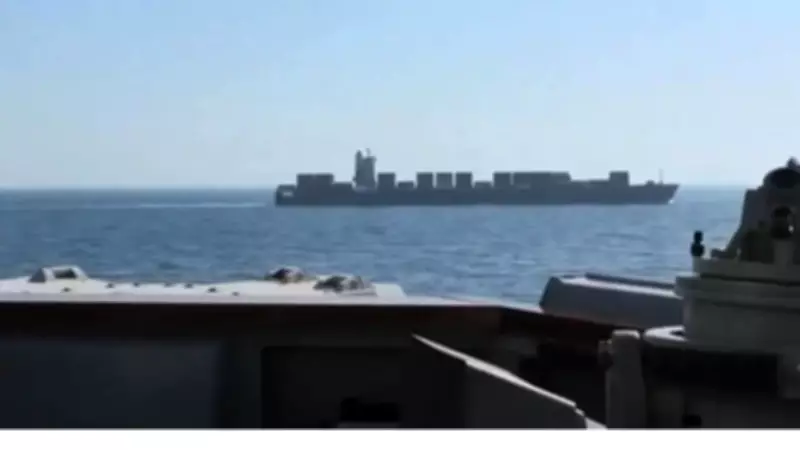
US Navy Seizes Iranian Cargo Ship TOUSKA in Gulf of Oman Confrontation
In a dramatic escalation of maritime tensions, United States naval forces have intercepted and seized an Iranian-flagged cargo vessel named TOUSKA near the strategic Strait of Hormuz. The incident occurred on Sunday as the ship attempted to bypass an American naval blockade, according to statements from US officials.
Trump Announces Seizure on Social Media
Former US President Donald Trump took to Truth Social to announce the operation, writing: "Today, an Iranian-flagged cargo ship named TOUSKA... tried to get past our Naval Blockade, and it did not go well for them." He detailed that the USS Spruance, a guided missile destroyer, intercepted the vessel in the Gulf of Oman and issued repeated warnings over six hours.
"The Iranian crew refused to listen, so our Navy ship stopped them right in their tracks by blowing a hole in the engine room," Trump continued. "Right now, US Marines have custody of the vessel. The TOUSKA is under US Treasury Sanctions because of their prior history of illegal activity. We have full custody of the ship, and are seeing what's on board!"

Official US Military Account
US Central Command (CENTCOM) provided additional details, confirming that forces operating in the Arabian Sea enforced naval blockade measures against TOUSKA as it attempted to sail toward Bandar Abbas, Iran. According to CENTCOM, the vessel was traveling at 17 knots when intercepted in the north Arabian Sea.
The military command stated that US Marines from the 31st Marine Expeditionary Unit boarded the "non-compliant vessel" after the failed warnings. CENTCOM emphasized that forces acted in a "deliberate, professional, and proportional manner" and noted that since the blockade began, 25 commercial vessels have been directed to turn around or return to Iranian ports.
Iran's Conflicting Accounts
Iran initially presented a contradictory version of events through state-linked media. The semi-official Mehr news agency reported that "American terrorist forces deployed to the waters surrounding the Sea of Oman and opened fire on an Iranian merchant ship to force it to return to Iranian territorial waters."
The Iranian report claimed that with "the timely presence and rapid response of the IRGC naval units in support of the Iranian ship, the Americans were forced to retreat and flee the area." This account did not name the specific vessel involved and directly contradicted Trump's claim of successful seizure.
Iran Confirms Seizure, Calls It 'Armed Piracy'
Hours later, Iranian authorities confirmed that a US operation had indeed targeted and seized one of their commercial ships. An official statement described the incident as "armed piracy" by American forces.
"The aggressive America, by violating the ceasefire and committing maritime piracy, attacked one of Iran's commercial ships... by firing upon it and disabling its navigation system by deploying several of its terrorist marines on the deck," the statement read.
The Iranian government issued a stern warning: "We warn that the Armed Forces of the Islamic Republic of Iran will soon respond to and retaliate against this armed piracy by the US military."
Diplomatic Fallout and Ceasefire Concerns
This confrontation has significantly escalated tensions between the two nations just days before a fragile ceasefire agreement is set to expire. The incident casts serious doubt over ongoing diplomatic efforts that had shown tentative progress.
Trump had previously announced that US negotiators would travel to Pakistan for talks with Iranian representatives, but Tehran has not confirmed its participation in these discussions. Iranian officials have criticized what they describe as "excessive demands" and "ceasefire breaches" by the United States, raising questions about whether negotiations will proceed as planned.

The Strait of Hormuz remains one of the world's most critical maritime chokepoints, with approximately one-fifth of global oil consumption passing through these waters. This latest incident marks one of the most direct confrontations between US and Iranian forces in the region in recent months, potentially signaling a new phase of heightened military tensions.





