

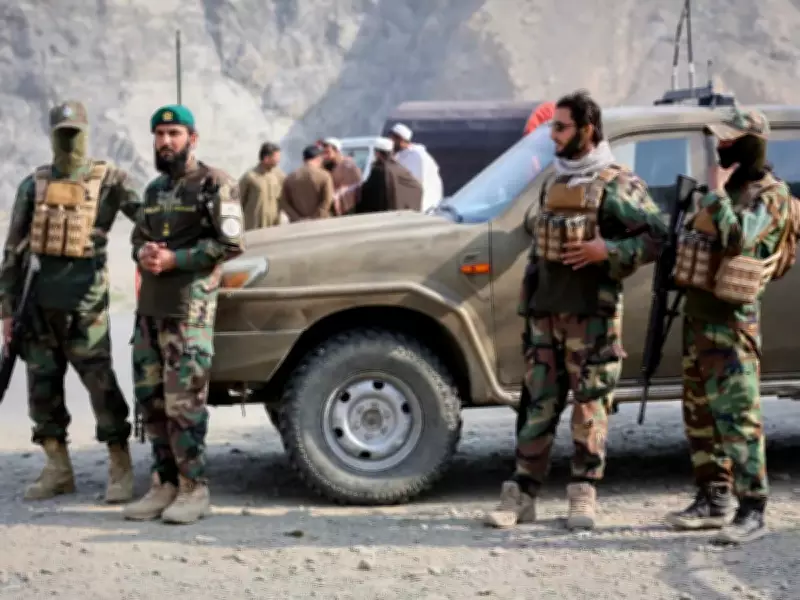
US Affirms Support for Pakistan's Self-Defense Amid Taliban Clashes
The United States has officially expressed its backing for Pakistan's "right to defend itself" against Taliban attacks, as tensions escalate along the Afghanistan-Pakistan border. This declaration came on Saturday following a series of military exchanges that have intensified regional instability.
Trump's Praise for Pakistani Leadership
Former US President Donald Trump offered strong praise for Pakistan's leadership during remarks at the White House. "Well, I would intervene, but I get along with Pakistan, as you know, very well. Very, very well," Trump told reporters. "You have a great prime minister, you have a great general there, you have a great leader. I think two of the people that I really respect a lot. I think Pakistan is doing terrifically well."
Trump specifically referenced Prime Minister Shehbaz Sharif and Chief of Defence Forces Asim Munir, highlighting his positive relationship with Islamabad's current administration.

Diplomatic Communication and Limited Support
US Under Secretary of State Allison Hooker later held a telephone conversation with Pakistan's Foreign Secretary Amna Baloch, during which she conveyed Washington's position. "Spoke today with Pakistan Foreign Secretary Amna Baloch to express condolences for lives lost in the recent conflict between Pakistan and the Taliban," Hooker wrote on social media platform X.
She continued, "We continue to monitor the situation closely and expressed support for Pakistan's right to defend itself against Taliban attacks." However, Hooker's statement notably stopped short of calling for an end to hostilities or urging de-escalation measures.
International Responses and Escalating Conflict
The US position contrasts with responses from other nations:
- The United Kingdom has called for "de-escalation" of tensions
- China has urged an immediate ceasefire
- Iran has offered to mediate between the parties
The current conflict escalated earlier this week when Pakistan launched airstrikes on major Afghan cities, marking its most significant military action in Afghanistan since the Taliban returned to power in 2021 following the US withdrawal. Subsequent Taliban retaliation triggered further Pakistani strikes, creating a cycle of violence.
Pakistan's Declaration of "Open War"
Pakistan's Defence Minister Khawaja Asif has declared that his country is now in an "open war" with Afghanistan, reflecting the seriousness of the current military confrontation. This represents a significant deterioration in relations between the neighboring nations.
Shifting US-Pakistan Relations
The Afghanistan conflict has created complex dynamics in US-Pakistan relations. During the Biden administration, Washington maintained distance from Islamabad, citing Pakistan's historical support for the Taliban during the period when the United States backed a pro-Western government in Kabul.
Trump has taken a markedly different approach, actively strengthening relations with Pakistan. Islamabad has publicly praised Trump for what it described as his mediation efforts during last year's military conflict with India and even suggested he deserved the Nobel Peace Prize for his regional diplomacy.
Regional Implications and Denials
New Delhi has repeatedly denied any US role in ceasefire negotiations between India and Pakistan, maintaining that the cessation of hostilities resulted from direct bilateral talks between the two nuclear-armed neighbors. This highlights the complex triangular relationship between the United States, Pakistan, and India in South Asian geopolitics.
The current situation represents a significant test for regional stability, with Pakistan facing security threats from Taliban militants while navigating complex international relationships. The US support for Pakistan's right to self-defense, coupled with Trump's praise for Pakistani leadership, suggests a potential shift in Washington's approach to the region, though the limited nature of the support indicates continued caution in directly involving itself in the conflict.






