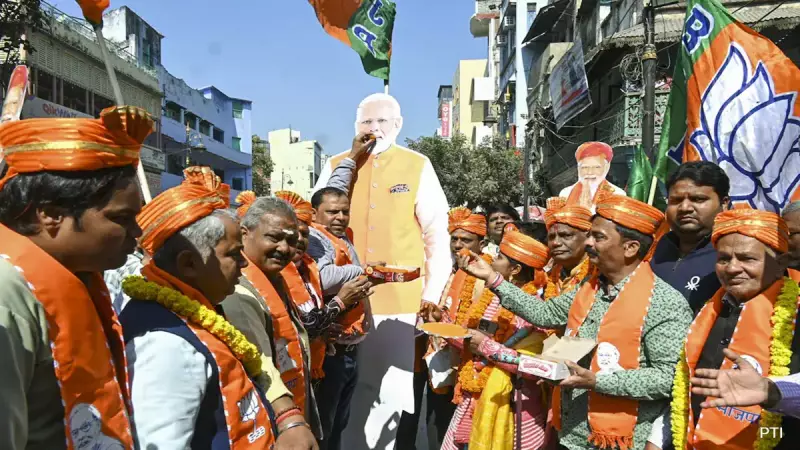
The Bharatiya Janata Party (BJP) has secured a decisive victory in the high-stakes Municipal Corporation of Delhi (MCD) elections held in 2025, reclaiming control of the capital's civic body. The election results, declared on December 3, 2025, mark a significant political development in the national capital region.
Complete Breakdown of MCD Election 2025 Results
According to the final tally, the BJP emerged as the single largest party, winning a commanding 126 seats out of the 250 wards in the unified MCD. The Aam Aadmi Party (AAP), which was hoping to consolidate its state-level power, managed to secure 55 seats. The Indian National Congress (INC) won 9 seats, while the All India Forward Bloc (AIFB) opened its account with 1 seat. A total of 59 independent candidates also won their respective wards.
The election saw a keenly contested battle, particularly between the BJP and the AAP. The BJP's campaign, focused on civic issues and development, appears to have resonated with the voters, leading to this clear mandate. The results are a crucial indicator of the political mood in Delhi ahead of future state and national polls.

Key Winners and Notable Contests
The list of winners includes several prominent faces and reveals interesting trends across Delhi's diverse constituencies. The BJP's victory was widespread, with wins reported from multiple zones including Rohini, Civil Lines, Karol Bagh, and Najafgarh. AAP managed to hold its ground in several strongholds, particularly in areas where it has a robust organizational presence.
Some of the key winning candidates from the major parties include:
- BJP: The party's candidates triumphed in wards like Shalimar Bagh, Patel Nagar, Janakpuri, and Greater Kailash. The wins underscore the party's pan-Delhi appeal.
- AAP: The party secured victories in wards such as Sangam Vihar, Seemapuri, and Kondli, areas traditionally considered its support base.
- Congress: The party's nine wins, though modest, indicate a flicker of revival in certain pockets, preventing a complete washout.
- Independent Candidates: The strong showing of 59 independents highlights localized issues and the influence of hyper-local leadership in municipal polls.
The election was conducted for all 250 wards of the unified Municipal Corporation of Delhi. The voter turnout was robust, reflecting the public's engagement with civic issues that directly impact daily life, from sanitation and water supply to infrastructure and urban planning.
Political Implications and the Road Ahead for Delhi
The BJP's sweeping victory in the MCD elections 2025 has major implications for Delhi's governance structure. It places the civic administration under the control of a party that is in opposition in the Delhi Legislative Assembly, where AAP holds power. This sets the stage for potential administrative and political tussles between the two bodies.
For the BJP, this win is a massive morale booster and is seen as a validation of its central and local leadership's policies. It strengthens the party's ground-level organization in the capital significantly. For AAP, the results are a setback, indicating a disconnect between its state governance and the civic expectations of Delhi's residents. The party will need to introspect on its campaign strategy and civic outreach.
The Congress's performance, while better than its previous outings, remains far from a revival, securing less than ten seats. The results solidify the political landscape of Delhi as a primarily bipolar contest between the BJP and AAP.
The newly elected councillors will now be tasked with addressing the perennial civic challenges of India's capital—waste management, sanitation, road maintenance, and urban development. All eyes will be on the BJP-led corporation to deliver on its promises and improve the quality of life for Delhi's citizens. The outcome also sets the narrative for the next Delhi Legislative Assembly election, making the political dynamics in the capital more complex and competitive.