

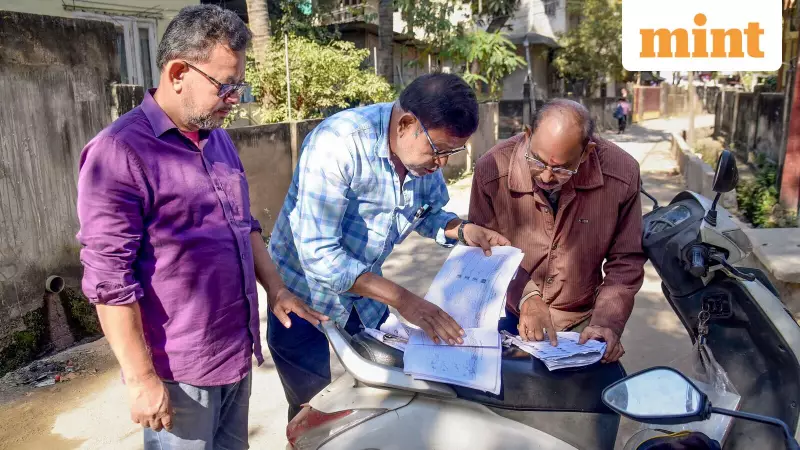
The Election Commission of India (ECI) on Tuesday took a significant step in electoral purification by publishing the draft voter lists for three states and two Union Territories. This follows the completion of the enumeration phase of the Special Intensive Revision (SIR) exercise in West Bengal, Rajasthan, Goa, Puducherry, and Lakshadweep.
Massive Deletions Reshape Electoral Landscape
The provisional draft rolls reveal a substantial churn, with over one crore voter names being deleted across these regions. The poll panel has mandated that Chief Electoral Officers (CEOs) and District Electoral Officers (DEOs) provide physical copies of these draft rolls to all recognized political parties. Simultaneously, the rolls have been made available online on the respective CEOs' and DEOs' official websites for public scrutiny.
Voters can now log in to verify their details and check lists that categorize individuals as absent, shifted, deceased, or duplicated. This transparency is a cornerstone of the SIR process, aimed at creating error-free electoral rolls.

State-Wise Breakdown of Voter Deletions
The scale of revision varies significantly from state to state, with major political implications.
In West Bengal, the electorate witnessed its most dramatic overhaul in decades. The draft list shows a reduction of over 58 lakh voters, shrinking the total from approximately 7.66 crore to just over 7.08 crore. The deletions, based on criteria like death, permanent migration, duplication, and non-submission of forms, have redrawn voter profiles in key districts, border areas, and high-stakes constituencies, setting the stage for a volatile run-up to the 2026 assembly polls.
Within the state, the data shows intriguing patterns. Chief Minister Mamata Banerjee's Bhabanipur constituency saw 44,787 deletions, nearly four times the 10,599 names struck off in Opposition Leader Suvendu Adhikari's Nandigram. Kolkata's Chowringhee recorded the highest absolute deletions at 74,553.
In Rajasthan, State CEO Naveen Mahajan reported that nearly 42 lakh names were removed from the draft rolls. Out of a total 5.46 crore electors, enumeration forms for 41.79 lakh voters could not be collected. The breakdown includes 8.75 lakh deceased voters, 29.6 lakh classified as shifted or absent, and 3.44 lakh enrolled at multiple locations. Jaipur registered the highest number of deletions in the state.
The Union Territory of Puducherry saw 1.03 lakh voters missing from the draft list, bringing the total down to 9.18 lakh from 10.21 lakh. In Goa, 1,00,042 voters were categorized as ASD (Absent, Shifted, Deceased) and deleted. This includes 72,471 shifted/absent, 25,574 deceased, and 1,997 duplicate entries. Lakshadweep reported a smaller cleanup, with 1,429 ASD voters removed.
Revised Timelines for Other States
The ECI also provided updates on the extended SIR schedules for other regions. The enumeration process in Tamil Nadu and Gujarat, initially delayed, is now set to conclude on December 14, with their draft rolls scheduled for publication on December 19.
Similarly, for Madhya Pradesh, Chhattisgarh, and the Andaman and Nicobar Islands, the door-to-door verification will end on December 18, and draft lists will be out on December 23. Uttar Pradesh, the largest electorate, has its enumeration deadline on December 26, with the draft electoral roll expected on December 31.
Political Reactions and Next Steps
The publication of the draft lists has immediately ignited political discourse. In West Bengal, the ruling Trinamool Congress (TMC) seized on the data, arguing that the SIR exercise undermines the BJP's frequent claims about the presence of 'one crore Rohingyas and Bangladeshis' as voters, noting the number of 'fake' or 'ghost' voters identified is around 1.83 lakhs.

Conversely, Union Minister Sukanta Majumdar defended the extensive deletions, stating they demonstrate why the SIR was necessary. The ECI has emphasized that the current draft is provisional. Claims and objections will be heard, allowing for corrections before the final list is published. This process is critical for ensuring every legitimate voter is included and ineligible entries are purged, thereby strengthening the integrity of the electoral process ahead of crucial state elections.





