

The Election Commission of India has initiated a significant drive in Kolkata to address discrepancies in the electoral roll, issuing hearing notices to lakhs of voters flagged as 'unmapped'. The formal hearing process is scheduled to commence on December 27, marking a critical step in cleaning up the voter list.
New Tech-Driven Process for Notice Delivery
A senior EC official revealed that by Monday afternoon, nearly 10 lakh hearing notices had already been generated. The remaining notices, part of a larger batch, are expected to be printed by Tuesday, potentially bringing the total to a significant number. The entire operation is being streamlined through technology.
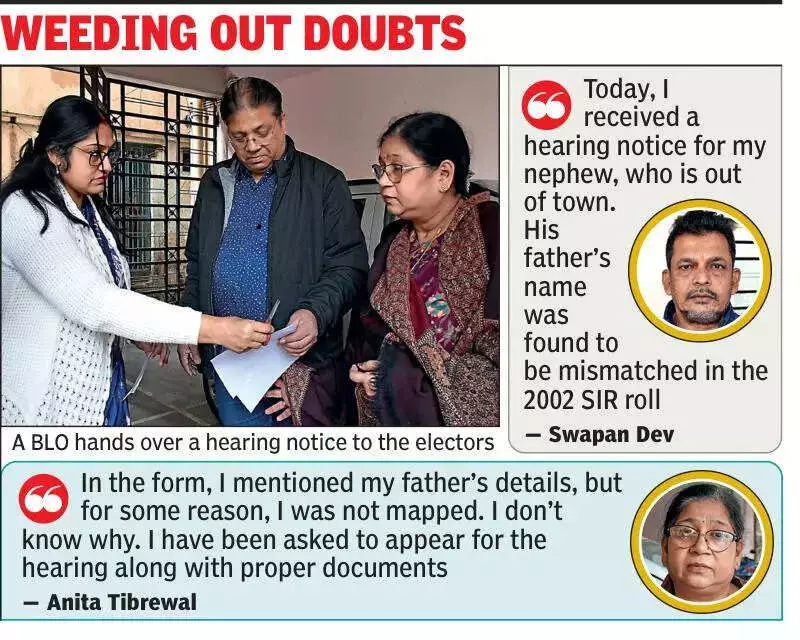
A new feature in the Booth Level Officer (BLO) application, called 'Delivery of Schedule Hearing Notice', is at the heart of this process. This feature meticulously records the delivery of each notice. BLOs are required to capture photographs of the recipients at the moment the hard copy of the notice is handed over, creating a digital audit trail for the Commission.

Who is Receiving These Notices and Why?
The notices are primarily targeting voters whose enumeration forms contained logical discrepancies or who were found to be 'unmapped' in the system. An official explained that out of approximately 1.4 crore unique cases of logical discrepancies identified, the Commission will decide the final number of individuals summoned for a hearing.
The hearings will not be confined to government administrative offices alone. Venues will include BDO, SDO, and DM offices, as well as BLLRO offices, government schools, and colleges. The Electoral Registration Officer (ERO) and District Election Officer (DEO) will finalize the school and college locations, with an assurance that no examinations will be disrupted for these hearings.
Voters Share Their Confusion and Frustration
The distribution of notices has led to confusion among many citizens. Nidhi Rai, along with seven family members, received a notice citing 'no-mapping' in the 2002 Summary Revision (SIR) roll. She clarified that her family moved to their current residence before 2002. While their names were deleted from their old address's voter list, they were not included in the new area's list in 2002, though their voter cards were later shifted.
In another case, Subrata Basak from Beadon Row received a notice despite his name being present in the 2002 SIR roll. The retired CESC officer expressed his bewilderment, stating it was "very absurd" that his name was considered missing when his family has been long-term residents.
Tapasi Maity, a Maniktala resident in her mid-forties, became a Kolkata voter after her marriage in 2016. She received a notice because, in her enumeration form for her in-laws' address, she mapped herself to her father and couldn't provide details like the booth number.
On the Ground: BLOs Execute the New Protocol
Booth Level Officers are actively implementing the new directive. Debasree Ray De Sarkar, a BLO, reported serving notices to about 100 unmapped electors in her assigned area. She detailed the process: "I have served hearing notices to the unmapped voters and uploaded their information on the BLO app. There is a provision for capturing the photograph of the person who receives the notice."
The app also specifies protocols for proxy receipt. If one person collects notices for family members, such as a parent for a child or vice-versa, or an uncle/aunt for a nephew/niece, the same recipient's photograph must be captured for each separate notice.
This large-scale exercise underscores the Election Commission's push to utilize technology for greater accuracy and transparency in the electoral roll revision process ahead of future polls.






