

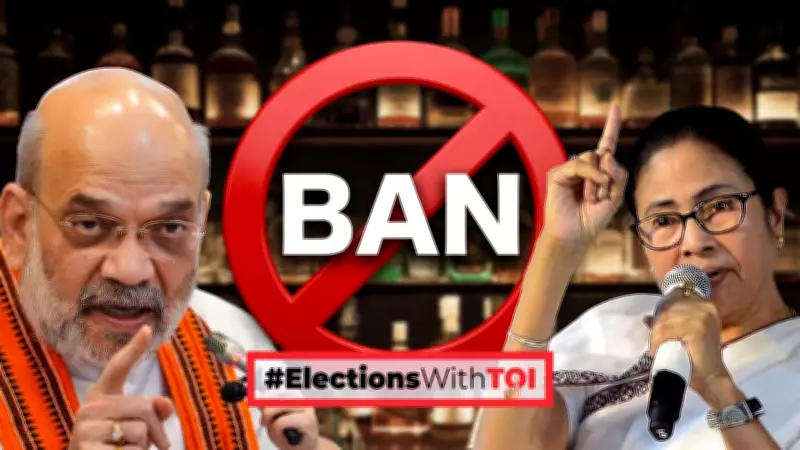
ECI Mandates Extended Dry Period in Poll-Bound States to Curb Electoral Malpractices
The Election Commission of India (ECI) has issued a stringent directive imposing a comprehensive "Dry Day" across key regions in two major states ahead of crucial assembly elections. In a decisive move to safeguard the integrity of the electoral process, the Commission has ordered a 96-hour prohibition on liquor in West Bengal and a 48-hour ban in Tamil Nadu.
Specific Timelines and Geographic Scope of the Ban
The order, enacted under the authority of Section 135C of the Representation of the People Act, 1951, mandates that the sale, service, and distribution of all alcoholic beverages must cease entirely in polling areas. This restriction is set to commence 48 hours before the conclusion of voting and will be rigorously enforced throughout the designated dry period.
For West Bengal, this translates to a substantial 96-hour liquor ban, while Tamil Nadu will experience a 48-hour prohibition. The directive explicitly applies to all establishments holding liquor licenses, including but not limited to hotels, exclusive clubs, restaurants, and bars. No exceptions are permitted during this critical timeframe.

Extension to Counting Day and Re-Poll Scenarios
In a significant expansion of the measure, the Election Commission has confirmed that the liquor ban will also be in full effect on the official counting day, scheduled for May 4. Furthermore, the prohibition will automatically apply in any constituencies where re-polls are necessitated, ensuring continuous enforcement throughout the entire electoral cycle.
Strict Enforcement Mechanisms and Legal Ramifications
The Commission has underscored the necessity for strict adherence to this order, with state authorities instructed to implement robust monitoring protocols. These include increased surveillance of liquor storage facilities, warehouses, and distribution channels to prevent any clandestine activities.
Any violations of this prohibition will be met with severe legal consequences, with actions to be pursued under relevant excise laws and electoral regulations. The ECI's primary objective is to eliminate any potential for voter inducement through the distribution of alcohol, thereby fostering a free and fair voting environment.
Broader Context and Electoral Integrity Measures
This liquor ban forms a critical component of the Election Commission's multi-faceted strategy to prevent electoral malpractices and uphold democratic principles. By curtailing the availability of alcohol during the sensitive pre-poll and counting phases, the ECI aims to mitigate undue influence and ensure that voters can exercise their franchise without coercion or manipulation.
The implementation of such measures reflects the Commission's proactive approach to addressing challenges that have historically plagued the electoral process in various regions. It signals a firm commitment to transparency and accountability as these states prepare for pivotal assembly elections that will shape their political landscapes.






