

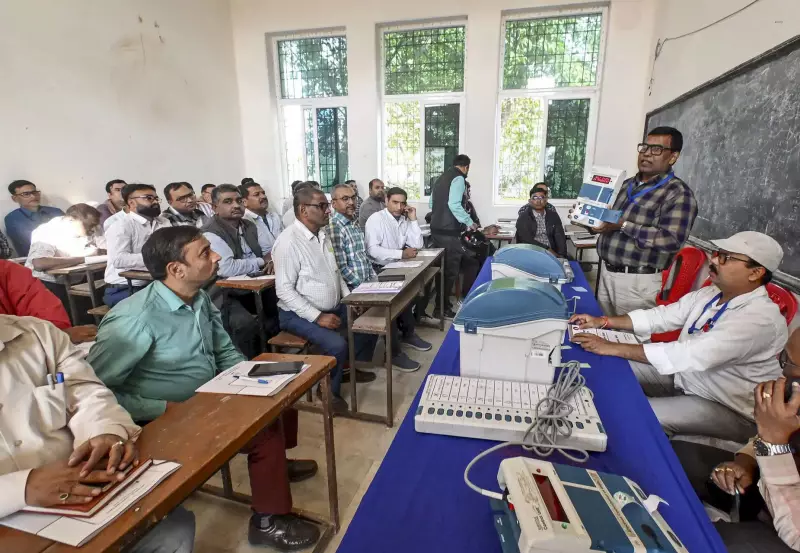
The Election Commission of India (EC) on Thursday issued a strong rebuttal to a series of allegations and false claims circulating on social media regarding the recently concluded Bihar assembly elections. The poll body categorically rejected any suggestion of irregularities in the counting of votes, labeling the accusations as "baseless and misleading."
EC Forced to Counter Persistent Misinformation
More than a month after the Bihar polls, where the NDA secured a historic victory, the Commission stated it was compelled to release multiple clarifications due to persistent misinformation online. It expressed concern that repeated claims questioning the credibility of the counting process were misleading voters and undermining public confidence in a well-established constitutional system.
The EC firmly dismissed suggestions of discrepancies during the vote tally. It emphasized that allegations of counting errors were "impossible and false." The Commission outlined the stringent protocols followed, noting that all Electronic Voting Machines (EVMs) were checked in the presence of candidates and their agents before counting began.

Detailed Rebuttal on EVMs and Voter Rolls
Addressing specific viral claims, the EC provided point-by-point refutations. It rejected the sensational claim that each EVM contained 25,000 pre-loaded votes before polling started. The Commission clarified that technically and administratively, this is impossible, as a control unit can record a maximum of 2,000 votes and a VVPAT printer can handle only 1,500 slips.
The poll body also dismissed theories about two different types of EVMs being used, with one set allegedly carrying preloaded votes. It termed this charge "imaginary, concocted and unsubstantiated," asserting that the ECI uses only one standard model of EVM (Ballot Unit, Control Unit, and VVPAT) across the country, with uniform certification and testing.
On the process, the EC stated that counting agents were present at every table, and round-wise results were displayed before them. It highlighted that from the sealing of EVMs to their storage in strong rooms, candidates and their representatives were present at every stage, with continuous monitoring by police, central forces, and CCTV.
Clarifications on Postal Ballots and Voter List Updates
The Commission also responded to the opposition's contention that results would have differed if voting was conducted via postal ballots. It explained that postal ballots are meant for a limited and specific category of voters, including service voters, election duty personnel, senior citizens above 85, and disabled voters. Their rejection follows a standardized legal process due to incorrect forms, mismatched signatures, or improper return.
Denying reports that the Summary Revision (SIR) of electoral rolls was a tool for "vote chori" (vote theft), the EC stated the process legally removes names of deceased persons, eliminates duplicate entries, updates details of shifted voters, and includes new eligible voters. It is not a process of reducing votes but of ensuring an accurate roll.
The EC addressed the addition of nearly 300,000 voters after the final electoral roll was published on September 30, stating it was done to ensure no eligible voter was denied their right. It also explained that CCTV footage from polling booths cannot be made public to safeguard the right to privacy and ballot secrecy, warning that public distribution could endanger voters and personnel and lead to profiling and false narratives.
An EC official said on Thursday that the Commission took note of various misleading posts and podcasts on social media and issued fact checks based on factual and legal information so that correct information could reach common voters according to the rules and laws governing elections.






