

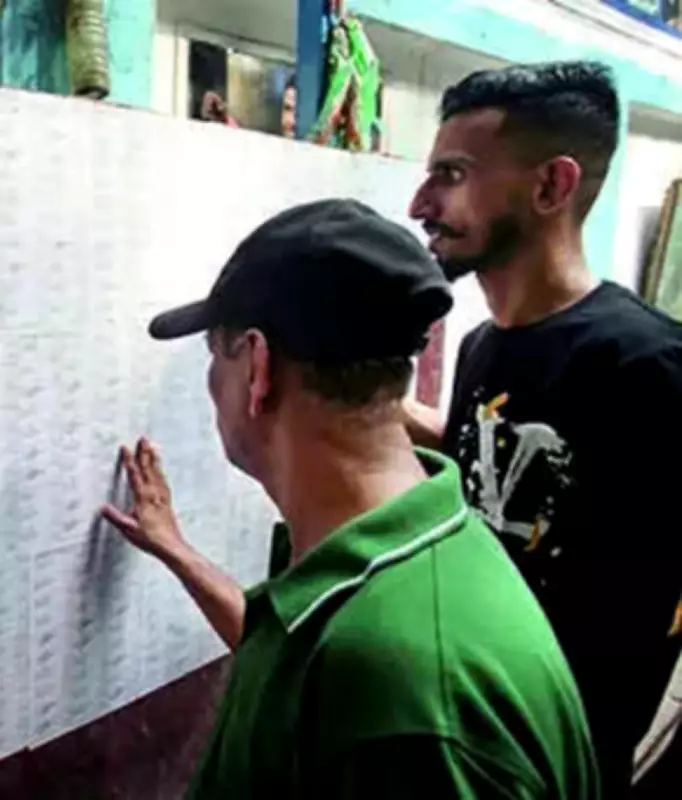
Electoral Roll Revision Deepens Gender Imbalance in Ghaziabad
The Special Intensive Revision (SIR) of electoral rolls in Ghaziabad has produced a counterintuitive outcome, worsening the district's gender imbalance rather than correcting it. While the exercise aimed to clean up voter lists, it has resulted in a significant decline in female voter registrations, with the Sahibabad assembly constituency experiencing the most severe impact.
Sahibabad Records Most Dramatic Decline
Ghaziabad's overall female-to-male voter ratio dropped from 811 to 789 per 1,000 male voters following the SIR exercise. This decline aligns with Uttar Pradesh's broader trajectory, where the state's gender ratio improved slightly from 824 to 834 during the revision but remains substantially below the pre-revision baseline of 877.
The most alarming statistics emerged from Sahibabad, where the gender ratio plunged from 779 to 685. The number of women voters in this constituency decreased by 35%, falling from 453,449 to 295,045. This decline was significantly steeper than the 26% reduction observed among male voters in the same area.

Varied Outcomes Across Constituencies
While Sahibabad suffered the most dramatic setback, other constituencies in Ghaziabad district showed mixed results:
- Muradnagar recorded the district's highest gender ratio at 863, up from 852, as male voters declined 14% compared to 13% for female voters
- Loni improved marginally from 808 to 820 for similar reasons
- Ghaziabad City edged up from 817 to 841, with male voters declining 17% against 14% for women
- Modinagar saw a slight decline from 859 to 851 as both genders experienced similar reductions
Structural Challenges in Sahibabad
Election officials attribute Sahibabad's disproportionate decline to the constituency's complex demographic composition. The seat encompasses diverse areas including upscale trans-Hindon enclaves like Indirapuram, Vaishali, and Vasundhara, alongside older middle-income colonies such as Shalimar Garden and Rajendra Nagar. Additionally, dense migrant-worker clusters in the Sahibabad Industrial Area, Arthala, and Mohan Nagar, plus urban villages including Khoda, Bhopura, Makanpur, and Pasonda, create significant challenges for accurate voter tracking.
Field officers conducting door-to-door verification reported that women were disproportionately affected by deletion drives. A recurring pattern involved duplicate registrations, particularly where women maintained entries at both parental and marital addresses.
"A pattern we kept seeing was women enrolled in two places — at their parental home and again at the husband's address after marriage," explained a booth-level officer deployed in Sahibabad. "When we verified, one entry had to go. In many cases, the original registration remained on paper even though the voter had shifted years ago, concentrating deletions among women."
Data Reveals Deletion Patterns
District election office data from Sahibabad shows that over 16% of total deletions were categorized as 'shifted' and another 16% as 'absent,' while 2% were recorded as deceased. Duplicate enrollments and other reasons accounted for the remaining deletions. Officials noted that the 'shifted' category was particularly pronounced in Sahibabad compared to other constituencies.
Gender rights expert Himani Agarwal, a member of the UP State Women's Commission for Ghaziabad, identified structural failures in how women navigate electoral re-registration after relocation. "Women often get removed from old rolls, but re-registration at the new address is delayed or missed altogether," she observed.
In high-mobility, industrial areas like Sahibabad, informal tenancies and limited awareness about transfer procedures compound the problem. "Add domestic responsibilities and childcare, especially in urban villages, and voter registration becomes a low priority. The result is visible in the falling gender ratio," Agarwal added.

Contrasting Results in Gautam Budh Nagar
Neighboring Gautam Budh Nagar district presented a different outcome, with its overall gender ratio improving from 817 to 828 following the SIR exercise. Female voters declined by 19% against a 20% fall among male voters, creating a narrow but consequential difference that allowed the district's gender balance to improve.
In Noida constituency, female voters dropped by 23%, from 340,337 to 262,708, but because male voters fell at an even steeper 25%, the gender ratio still improved from 790 to 810. Dadri showed a similar pattern, with the gender ratio climbing from 832 to 844, the highest in the district.
Jewar was the lone exception in GB Nagar, where a decline in female voters was higher at 16% against 14% for men, pushing its ratio down from 846 to 833.
Official Perspectives on Data Correction
GB Nagar District Magistrate Medha Roopam suggested the district's improved ratio reflects data correction catching up with ground realities. "Earlier, the district was still developing, and people were settling, hence the gender ratio was lower. With more people now settled here, including a large number of women working in garment factories, the SIR has corrected the data to reflect the district's actual demographics," she explained.
The contrasting outcomes between Ghaziabad and Gautam Budh Nagar highlight how similar electoral roll revision exercises can produce dramatically different results based on local demographics, migration patterns, and implementation challenges. The significant gender imbalance revealed in Ghaziabad, particularly in Sahibabad, raises important questions about ensuring equitable voter registration processes for women in rapidly urbanizing areas.





