

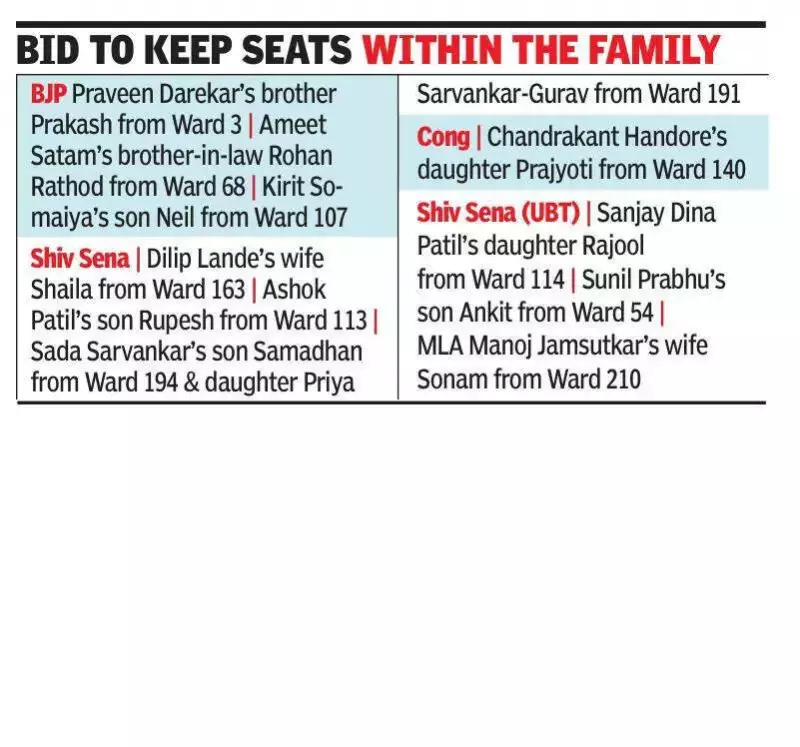
The upcoming Brihanmumbai Municipal Corporation (BMC) elections have laid bare the entrenched culture of 'family first' in Mumbai's political arena. A detailed scrutiny of the nominations filed reveals a startling trend: at least 43 politicians have managed to secure election tickets for their immediate and extended family members, sidelining dedicated party workers in the process.
The Scale of Dynastic Politics in BMC Races
The list of beneficiaries includes wives, children, siblings, in-laws, cousins, and even distant relatives. Leading the pack are BJP MLA Rahul Narwekar, Congress MLA Aslam Shaikh, and former NCP MLA Nawab Malik, each of whom successfully secured three tickets for their family members. Numerous other sitting MLAs and netas have obtained one or two tickets for their kin.
Political observers point to the multi-cornered contest, with the NCP not being part of the Mahayuti alliance and the Congress fighting solo, as a key reason for this scramble. This fragmentation created an opportunity for senior leaders to flex their muscle. They convinced their respective parties that fielding a family member was the safest bet, with parties often conceding to avoid electoral risks.

Parties Bow to Pressure, Selectively Ignoring Norms
While the Bharatiya Janata Party (BJP) has traditionally positioned itself against nepotism and dynastic politics, it too appears to have succumbed to pressure this season. The party granted three tickets to MLA Rahul Narwekar's relatives. Furthermore, MLC Praveen Darekar's brother, Prakash, will contest from Ward No. 3 in Dahisar.
However, this favoritism was selective. For instance, the BJP did not grant a ticket to the brother of Minister Ashish Shelar, Vinod Shelar. This selective approach, as one observer noted, was exercised purely for "convenience", highlighting the arbitrary nature of ticket distribution.
Beyond Immediate Family: The Extended Quota
The nepotism net was cast wider than usual. Many politicians extended beyond their typical 'family-first quota' of spouses, children, and siblings. Tickets were also secured for in-laws and distant relatives, indicating an aggressive effort to consolidate family influence within the civic body.
The consequence of this trend is the marginalization of long-waiting party workers and office-bearers who have dedicated years to grassroots work. With tickets being treated as family heirlooms, the democratic process within parties and the representation of ordinary cadres take a significant hit. This development sets a concerning precedent for governance and political accountability in India's financial capital.






